
Case Study: Why HRT chose Teledyne’s mobile mapping spherical camera for Taipei Metro’s tunnel inspection systems
HRT Corporation chose Teledyne Vision Solutions Ladybug camera series to develop a high-speed railway inspection system.
“During the most critical phases of our development, Teledyne experts became an anchor for us. Through their countless late-night troubleshooting sessions, relentless technical cross-examinations, constant support, and dedication we were able to cut through the noise and quickly lock in the perfect imaging solution for our client.”
— Allen Wei, General Manager at HRT Corporation Ltd
Summary
This customer story describes how HRT® Corporation helped Metro Taipei® (TRTC) update its tunnel inspection process by combining 2D LiDAR with Teledyne® 360-degree imaging system. It outlines challenges with traditional measurement methods, the value of adding 360° high resolution visuals to LiDAR data, and improvements in efficiency and safety. The case also demonstrates the real-world benefits of Teledyne Ladybug® camera series for railway infrastructure maintenance.
Table of Contents
-
Introduction
-
Challenges
-
2D LiDAR Integration with Ladybug5+
-
HRT’s Client Impact
-
Conclusion
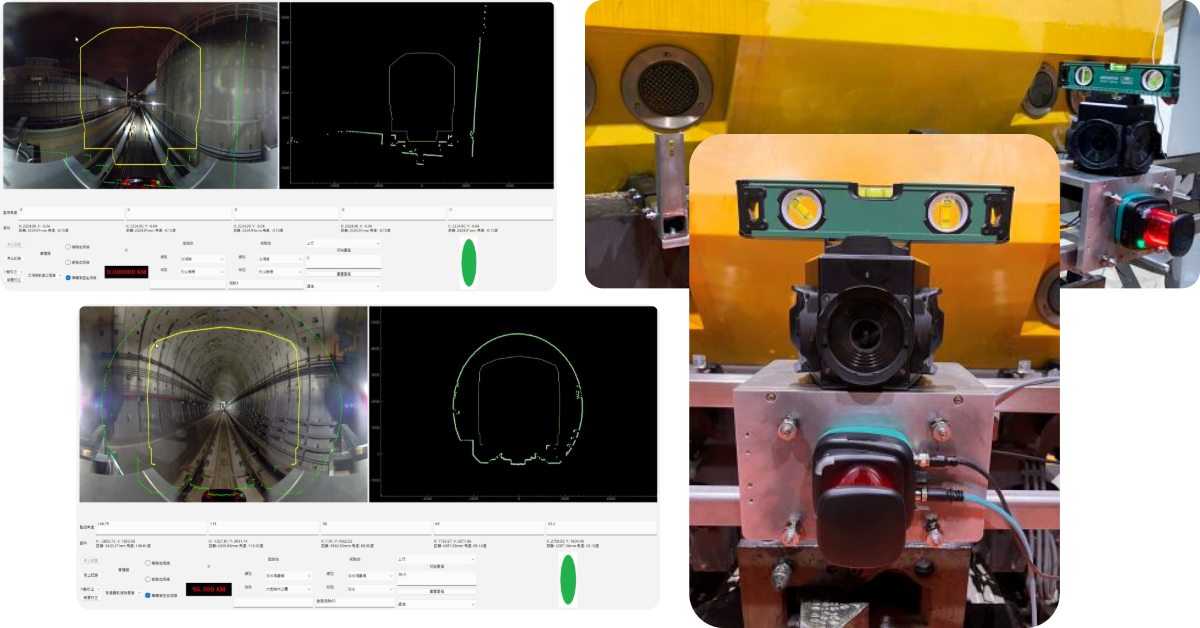
Ladubug5Plus mounted on a high speed metro line.
Introduction
Founded in 2012, HRT Corporation provides measurement and monitoring solutions for aviation, automotive, and maritime applications. The company supports clients with system design, equipment selection, data integration and analysis, to boost quality and efficiency.
"Our mission is to design and develop advanced inspection mobile systems for uncompromised railway safety."
— Allen Wei, General Manager at HRT Corporation
HRT and Taipei Metro
HRT designed and integrated a vehicle-based railway inspection system for Taipei Metro (TRTC), to support infrastructure monitoring and maintenance. The system is used by the Taipei Metro's Preventive Maintenance Section, within the Rolling Stock Department, to conduct annual tunnel clearance gauge measurements. This critical safety task ensures the tunnels remain within set spatial limits so trains can operate safely and reliably across the network.
Metro Tunnel Clearance Safety Requirement
Taipei Metro operates in a dense and tightly constrained tunnel environment. Infrastructure elements such as cables, pipes, and platform edges must always remain clear of the train’s defined clearance envelope to ensure safe operations.
Clearance gauge measurement is essential for ensuring a safe margin. It is used to:
- Monitor the spatial relationship between rolling stock and surrounding structures
- Detect potential encroachments before they develop into safety risks
- Support preventative maintenance planning and ongoing operational safety assurance.
“For Taipei Metro, managing network clearance is not just a technical requirement. It concerns the lives of millions of passengers every day. Ensuring structural clearance through precise monitoring is first line of defense against operational hazards. By proactively identifying potential encroachments, we guarantee that the trains run safely, smoothly, and without interruption across entire network.”
— Allen Wei, General Manager at HRT Corporation Ltd
Challenges
Limitations of Existing Measurement Methods
Before deploying the new system, Taipei Metro used a vehicle-based 2D LiDAR scanner to capture clearance profiles. Although this method provided accurate measurements, it only produced two-dimensional data. Without a correct visual context of the tunnel, the operators could not identify what was causing the clearance violations. The existing LiDAR system was also discontinued, raising concerns about long-term system sustainability.
Complexity of Alternative Technologies
During system development, HRT evaluated alternative sensing technologies and determined that:
- 3D LiDAR point clouds are affected by train speed, producing complex data patterns
- Processing these data sets for clearance inspection adds unnecessary complexity
- This level of complexity wouldn’t align with the practical requirements of routine clearance measurement
"Designing for high-speed railway inspection demands a delicate balance: the hardware must remain simple and reliable to endure harsh outdoor conditions, while the software must deliver absolute interpretability. Capturing flawless, high-resolution images on a fast-moving platform is a massive physical challenge, but our true goal is turning that raw data into clear, explainable insights that maintenance teams can trust instantly."
— Allen Wei, General Manager at HRT Corporation Ltd
2D LiDAR with Ladybug5+ Mobile Mapping System
To address these challenges, HRT developed an Integrated Monitoring System that combines 2D LiDAR with a 360‑degree spherical imaging system using Teledyne’s Ladybug camera series.
Why Teledyne’s Spherical Imaging Camera
During development, the integration of a Ladybug spherical imaging camera was identified as the ideal solution for the application. The Ladybug5+ camera provides:
- Full 360‑degree visual coverage of the tunnel environment
- Simultaneous visibility of the left and right sides of the inspection vehicle
- High‑resolution imagery of areas where encroachments are most likely to occur, including cables, pipes, and platform edges
“The primary advantage of using the 360° spherical camera system in our scenario is the ability to capture high-resolution imagery of both the left and right sides of the inspection vehicle simultaneously. These specific areas are where cables, pipes, and platform edges are most likely to encroach into the train’s path, allowing for precise visual verification alongside the LiDAR data.”
— Allen Wei, General Manager at HRT Corporation Ltd
Complementary Roles of LiDAR and Imaging
In the integrated system each sensor plays a clear role. The 2D LiDAR provides precise clearance profiles, while the Ladybug5+ imagery adds visual context, allowing operators to:
- See the real‑world tunnel environment with measurement data
- Identify and confirm specific objects affecting clearance conditions
This approach keeps LiDAR measurement reliable and adds environmental context.
"By delivering highly interpretable AI diagnostics alongside raw visual evidence, the system has boosted engineering inspection confidence to 99.8% while reducing manual data review time by over 45%."
— Allen Wei, General Manager at HRT Corporation Ltd
HRT’s Client Impact
The integrated system enabled Taipei Metro to:
- Perform annual clearance gauge measurements as part of its preventative maintenance program
- Monitor clearance envelopes while maintaining operational safety
- Visually verify potential encroachments within the tunnel environment
- Improve interpretability of inspection results by pairing geometry with imagery
“Inegrating advanced inspection technologies into a unified platform has transformed our approach from reactive maintenance to proactive prevention. By replacing fragmented inspections with this integrated system, we not only minimize staff exposure to high-risk track environments but also maximize deployment efficiency. We are now fixing potential issues before they impact daily operations, significantly elevating both track safety and maintenance performance.”
— Taipei Metro
Additional advantages of the new integrated system
Equipment weight: The new system weighs one-third to one-half of the original system, making installation and disassembly easier.
Relevant data: Operators can review Ladybug5+ images from five seconds before and after key timing points.
Warranty: Core system components are backed by device manufacturer warranties.
Conclusion
By combining 2D LiDAR with Teledyne’s Ladybug spherical imaging, HRT delivered a practical inspection solution tailored to real‑world railway operations.
Early collaboration with Teledyne imaging experts helped streamline system development and ensure the right technology choices from the start.
This approach accelerated development and improved outcomes of HRT Corporation, while delivering long-term value for Taipei Metro.