COSMOS: Fast Wide-Field Astronomy at CAHA
Dr. Gilles Bergond
Calar Alto Astronomical Observatory (CAHA), Spain
Background
Dr. Gilles Bergond is a support astronomer at the Calar Alto Astronomical Observatory (CAHA), the largest optical observatory in continental Europe. Dr. Bergond’s research focuses on observational astronomy and monitoring various spatial objects, as he states, “We are typically looking for faint targets from within the Solar System, to near‑Earth objects, exoplanet transits, and emerging time-domain phenomena”. The underlying scientific goals require detecting faint targets, to perform precise photometry and to observe fast astrophysical events.
Dr. Bergond’s team is currently in the process of upgrading instrumentation on their 1.23m telescope to maintain it and to extend its capabilities to modern applications. His team has now acquired a modern detector capable of delivering both high photometric accuracy, high temporal resolution and large field coverage, as he states: “We needed an efficient instrument with exquisite photometric accuracy. We would like to reach this new time-domain astronomy to observe very quick astrophysical phenomena like stellar occultations.”
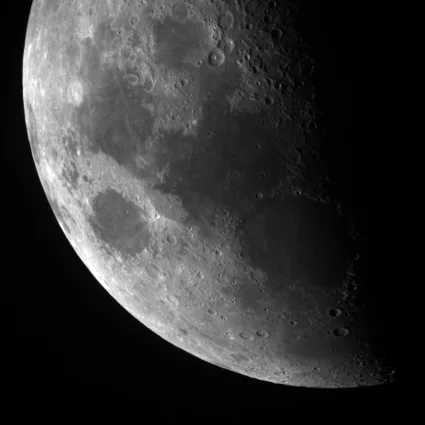
Figure 1: The Moon, imaged on CAHA's 1.23 m telescope, 1 ms exposure and 14-bit bit-depth. Acquired with the COSMOS-6K.
Challenges
Previous detector technologies (primarily using CCD sensors) have enabled decades of successful astronomical research but are reaching their limits when used for challenging modern applications. Dr. Bergond states that “the slow readout speeds and the limited dynamic range (typically 16‑bit) make it challenging to use them for high frame-rate observations or very bright celestial bodies… we are used to 16‑bit analog-to-digital converters, this is the typical saturation limit. One might obtain saturation artifacts such as bleeding when observing a very bright star.” Another limiting factor of older CCD sensors when performing photometry-based approaches are “the fringing artifacts in the far-red spectral region” limiting their usability in one of the most interesting spectral ranges.
CMOS detectors are definitely winning the game with respect to CCDs; they are now faster and as sensitive or even more sensitive than typical CCDs. On cameras like the COSMOS, you also don’t get fringing in the far-red spectrum.
Dr. Gilles Bergond, CAHA
Solution
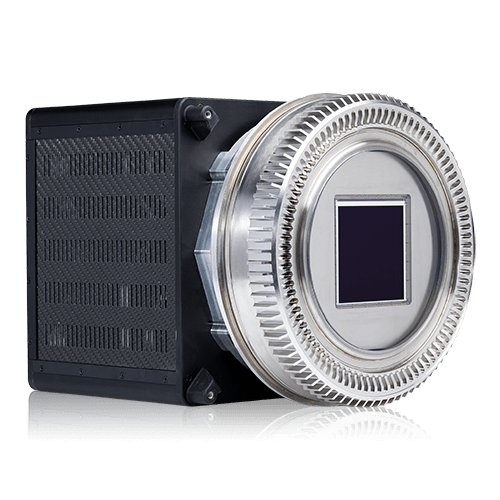
The COSMOS 6K CMOS camera from Teledyne Princeton Instruments is a perfect match for the 1.23m telescope at the Calar Alto Observatory. The large 65 x 65 mm (92 mm diagonal) sensor allows for imaging across an exceptional field of view (FOV).
Dr. Bergond described his experience with the COSMOS-6K, “this implies a field of view of around 22.6'x22.6' arcminutes. Basically, the Moon nearly fits inside this field of view.” This capability is displayed in Figure 1, where an image of the Moon was acquired directly after installing the COSMOS-6K on the 1.23 m telescope, without any calibration or correction.
In addition to the sensor size, the CMOS chip architecture enables faster imaging: “[COSMOS] is fast, reaching 22 frames per second in full frame. We could even reach more than 100 frames per second on a smaller field of view. We can use it both for deep imaging and very fast photometry” Dr. Bergond mentions. Furthermore, the cameras of the COSMOS series are embedded in the Lightfield software, allowing user-friendly steering of the instrument: “It was plug‑and‑play with the software… very intuitive “, according to Dr. Bergond. Finally, astronomy applications often present a challenge when imaging objects with different brightnesses. “With this extended high dynamic range of 18 bits, you can see from bright regions to faint ones without saturation.”
The features of the COSMOS demonstrate how modern CMOS technologies have become the gold standard for ground-based astronomy and provide an instrument surpassing former CCD detectors.