
Optical Control of Topological Chern States in Moiré Materials
Prof. Ataç İmamoğlu, Dr. Olivier Huber
Quantum Photonics group, Department of Physics, ETH Zürich, Switzerland
Background
Professor Ataç İmamoğlu's group at ETH Zürich explores quantum optics and many‑body physics in 2D materials, sitting at the intersection of quantum physics, condensed‑matter physics, and light–matter interactions. One of Prof. İmamoğlu's PhD students, Olivier Huber, mentions: “The broad scope of our research is to investigate strongly correlated electronic systems in 2D materials.” Mr. Huber's thesis focuses on quantum materials, such as twisted bilayer MoTe₂, where he investigates its unique electronic and topological properties through optical measurements, leading to a recent 2026 Nature publication, "Optical control over topological Chern number in moiré materials" (Huber et al. 2026), reaching a new milestone for programmable topological electronics.
This research demonstrates the first fully-optical control of a topological Chern number in a strongly correlated moiré material, namely twisted MoTe₂ (t‑MoTe₂) homo-bilayers. The Chern number is a toplogical invariant that characterizes the global properties of electronic bands in a material, by stacking two monolayers of the same material with a set rotational mismatch, a periodic superlattice potential is generated for the charges injected in the system. Generating a moiré material out of MoTe₂ homo-bilayers with rotational mismatches dramatically alters their electronic behaviour, yielding flat bands and allowing for strong correlations, which are otherwise absent in the untwisted (or monolayer) material. Exotic phases such as superconductivity or topological states have been observed in t-MoTe₂ homo-bilayers for specific twist angles of around 3.5°. In particular, the valence bands of t‑MoTe₂ are topologically non-trivial and are characterized by valley‑contrasting Chern numbers (±1). A visual depiction of the sample geometry, the t‑MoTe₂ device and its flat topological valence bands with finite Chern numbers C = ∓1 is shown in Fig.1.
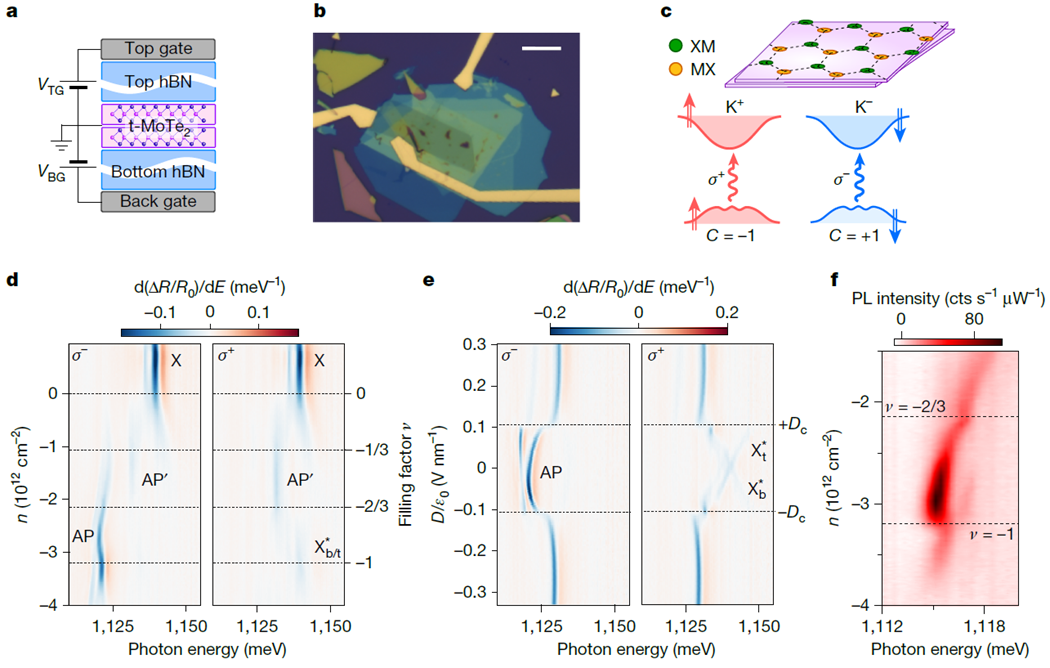 Figure 1: Information on the t-MoTe2 bilayer materials. A) Schematic of a t-MoTe2 bilayer with a target twist angle of 3.5°, embedded between two hBN flakes and further sandwiched between two transparent graphene gates. B) Image of the t-MoTe2 bilayer, scale bar 20 µm. C) Schematic of an effective honeycomb moiré superlattice potential for layer-hybridized holes, which leads to flat topological valence bands with finite Chern numbers (C = ∓1) in K± valleys that couple to σ±-polarized light. D/E), Differentiated reflectance contrast spectra d(ΔR/R0)/dE detected in two circular polarizations as a function of ν at fixed D ≈ 0 (D) and a function of D at fixed ν ≈ −1 (E). The spectra were measured at a small magnetic field B ≈ 50 mT required to initiate the spin orientation of newly injected holes on changing the gate voltages. F) Doping-density evolution of nearly resonantly excited PL spectra measured at D ≈ 0. The cusps in the trion emission energy are due to ICI and FCI formation. Figure adapted from (Huber et al. 2026).
Mr. Huber has developed a circularly polarized optical orientation technique that flips the spin–valley degree of freedom of holes, “In the K⁺ valley the holes occupy a topological non-trivial electronic band with a Chern number of −1, and in the K⁻ valley with a Chern number of +1. We can address these valleys independently using σ⁺ or σ⁻ polarized light. We observed that shining resonant σ⁻ polarized light transfers the charges from the K⁺ to the K⁻ valley… and the charges are thus now occupying an electronic band with a different Chern number”. This is achieved by narrowband excitation tuned to the attractive polaron resonance, a hole‑polaron complex whose optical helicity is tightly linked to the valley population. Because attractive polaron transitions show complete circular polarization when the hole system is fully valley‑polarized, they serve as a high‑fidelity optical readout of spin–valley orientation, shown in Fig.1D/E. The experimental evidence confirms that this optical switching does not heat the system or destroy the underlying topological order: both the ICI and FCI phases remain incompressible after optical pumping. Mr. Huber mentions: “these puddles of opposite spin… are stable over many hours”, referring to the stability and the long-lived character of the optically switched spin states.
The work establishes a powerful new method to manipulate the topological order parameter of correlated electronic systems using purely optical means, without the need for large magnetic fields, ultrafast heating, or electronic contacts. It opens possibilities for dynamically reconfigurable topological phases, optical generation of chiral edge states, and, as Mr. Huber mentions, “you could imagine reprogramming a topological circuit using light.” The results mark a major advance in topotronics, demonstrating that topological quantum phases in moiré materials can be written, controlled, and probed with light.
Challenge
The research project met various challenges starting with the sample preparation. Mr. Huber mentions “the most difficult part is the stacking procedure itself”, when describing the sample preparation procedure. After successfully stacking the two MoTe₂ layers, the observed effects depend on the angular shift between the two layers, “it’s extremely rare to have one full sample with the same homogeneous twist angle [...] the sweet spot for topological states in t- MoTe₂ is really around 3.5°.” Another challenging aspect in this process is the large physical size of the monolayers required from the exfoliation procedure for the stacking step.
The optical detection in the experiments rely on ultrasensitive near infrared (NIR) spectroscopy and imaging emissions around 1.05-1.13 µm, where signals are intrinsically weak and measurements are performed at cryogenic temperatures. The project thus requires a detector that meets the demanding sensitivity, stability, and integration-time requirements (50 ms to ≥10 s) of this project, all of which are critical to resolve valley and spin selective resonances in reflectance and photoluminescence (PL). Among the common semiconductors with matching sensitivity in the NIR range, InGaAs arrays are most frequently used. However, the noise levels of such arrays are limiting the accuracy of the results.
Solution
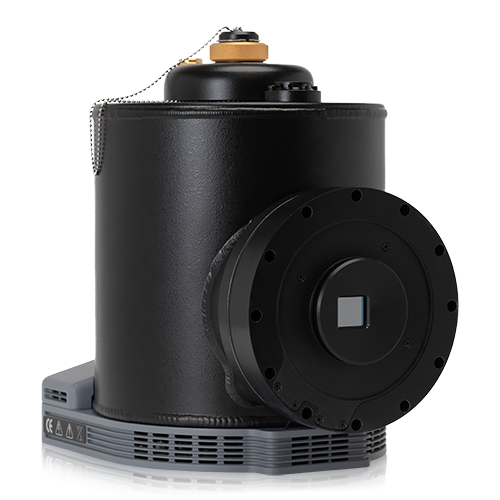
An ideal solution for whenever highly sensitive NIR imaging and spectroscopy is required is the NIRvana InGaAs family from Teledyne Princeton Instruments. The NIRvana LN, cooled with liquid nitrogen, is one of the lowest noise and highest sensitivity InGaAs cameras in the world, and is the ultimate solution for NIR imaging and spectroscopy of these novel, challenging materials.
Prof. İmamoğlu combines the NIRvana LN with a Teledyne Princeton Instruments SP2500i spectrograph, an ideal match for this project. Compared with previous InGaAs arrays, the NIRvana LN delivered significantly higher sensitivity, as mentioned by Mr. Huber: “The NIRvana LN allowed us to have many more counts for the same amount of power.” With low read noise levels (below 15 electrons) resembling common CCD devices and on-chip integration of up to one hour with high dynamic range (almost 400k electrons full well capacity), the NIRvana LN leverages NIR detection to scientific levels, an essential feature for detecting weak optical resonances.
In this project, the NIRvana LN presents unprecedented sensitivities for NIR detection (from 900–1600 nm), enabling reflectance contrast spectroscopy, photoluminescence mapping of topological phases, spatially resolved measurements of Chern domains, and polarization‑sensitive pump–probe studies of spin–valley control. By providing stable, precise detection of faint NIR signals across long integrations, the camera made it possible to resolve valley‑contrasting Chern bands, identify incompressible phases, write topological edge modes, and measure optical switching of the Chern number with high fidelity.
Reference
Learn More About The NIRvana LN