High-Speed Single-Molecule Flow Cytometry
Dr. Aleks Ponjavic
Faculty of Engineering and Physical Sciences, School of Physics and Astronomy, University of Leeds, UK
Background
Associate Professor Aleks Ponjavic of the University of Leeds is a single-molecule light-sheet specialist, here’s what he said about his latest research projects, “My motivation is from the immunology field, where we ask how an immune cell can recognise pathogens or peptides on tumours. If you have a cancer patient expressing five copies of CD19 or another target, is that enough for activation or for killing the tumour? To answer this, we need to detect single-molecule targets on the surface of cells, in 3D, as they flow at around 10 cells per second for high-throughput cytometry.”
“I’m a single-molecule light-sheet person, I’ve built a lot of imaging systems and now I’m asking how quickly we can do this kind of imaging. If we have cells flowing through an oblique light-sheet for sectioning, and the right probes for single-molecule detection, you get a very nice setup because you can do single objective 3D imaging in a high-throughput manner.”
“We’re getting to the point where we need to do 1,000 frames a second or more, to image over 100,000 cells, looking for bright, dim or negative expression of a wide range of markers and probes, all while avoiding autofluorescence.”

Figure 1: Jurkat T cells imaged under flow using dual Prime BSI Express cameras. Flow is from left to right, with 10 cells captured in a 2 second window. Both fluorescence and brightfield views shown, scale 100 um.
Challenge
There are numerous challenges involved in imaging single-molecule targets within multiple cell types as they move through a light sheet under flow. Dr. Ponjavic explained a few of these imaging challenges, “Our fluorescent probes are specialised nanoparticles, tiny ones with multiple fluorophores. We need to image with a high NA objective to resolve these within fast-moving cells in 3D for high-throughput characterisation. We are aiming for sub-cellular resolution in 3D for every cell that passes the camera field of view through the light-sheet.”
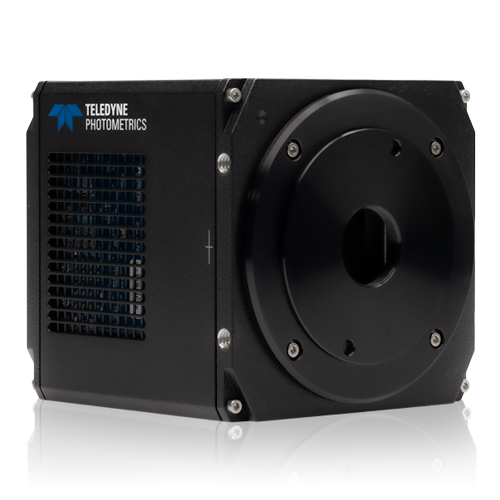
“With faster imaging we can use faster flow, at the moment we’re doing five millisecond exposure, but I’ve shown that one millisecond is possible, for this we need cameras with higher throughput, like the Kinetix.
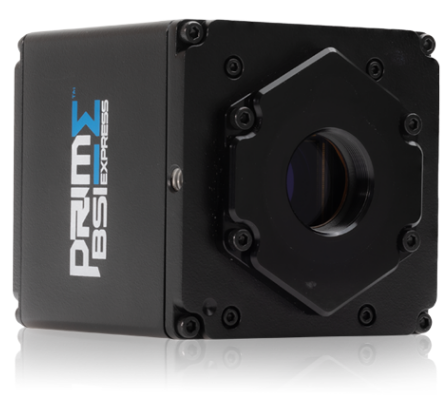
“Our Prime BSI Express cameras image single molecules within thousands of cells moving under flow, imaging at 1,000 fps or more. We’re happy overall, the experience with Photometrics has always been good for light-sheet.”
Dr. Aleks Ponjavic
Solution
Dr. Ponjavic has the ideal solutions for this application, which requires high-speed, high-sensitivity and high spatial resolution, “We are using two Prime BSI Express sCMOS cameras, one for each channel for simultaneous imaging. One camera for imaging single molecules, and another for cells, because if you have a cell with no fluorescent molecules inside you need to know. We’ve published recently with this set-up, demonstrating single-molecule flow cytometry (smFC) with a high NA oblique-plane microscopy light-sheet.”
“We also have a Kinetix, would allow us to go faster and increase the flow, and possibly use the larger FOV to use a wider flow channel and process more cells in a more high-throughput way.”
“I have used Photometrics products for a long time, over 12 years. In 2014 I joined the Klenerman Lab and the Lee Lab, we started with EMCCDs and then the Prime 95B came out and we were sceptical, but when we compared them, it was very good, it was superior in every way except at super low light sensitivity. We were having issues with our EMCCD vacuum, which Photometrics replaced, but with the newer CMOS cameras we don’t have these problems any more, the support has always been good. We’re happy overall, the experience has always been good with the light-sheet, and the price is reasonable for what it is. I haven’t felt the need to go anywhere else, essentially, and now we have the Prime BSI Express cameras and the Kinetix.”
Reference
Amir Rahmani, Matthew Christie, Amy Truesdale, James Thorne, Aleks Ponjavic, Single-molecule flow cytometry, bioRxiv 2025.08.26.672174; doi: https://doi.org/10.1101/2025.08.26.672174
Learn More About The Prime BSI Express