
From Sensor to Host: System Architecture Considerations for High-Resolution, High-Throughput Imaging
Global manufacturing environments are rapidly adopting higher‑resolution sensors, faster inspection lines, and increasingly complex multi‑camera architectures. As these systems scale up, machine vision solution providers are discovering that the most serious challenges rarely originate in the camera itself. Instead, failures emerge at system level when interfaces, drivers, host architectures, and synchronization layers all need to operate together with absolute consistency. Systems that perform flawlessly in the lab can become unstable weeks into production once bandwidth margins, timing behaviors, and host‑side processing are subjected to real world stress.
This shift from the performance of a component to the performance of a system has become a defining characteristic of modern high‑resolution imaging. Addressing it requires more than faster sensors or higher interface speeds; it demands architectural decisions that account for sustained throughput, observability, and failure modes across the entire imaging system.
Data Growth Is Outpacing Traditional Architectures
Across projects, machine vision solution providers consistently observe that high-resolution sensors expose system-level weaknesses earlier than expected. A 16K line scan camera operating at one million lines per second (1MHz) can generate roughly 164 Gbps of data, exceeding what a single link or standard PC can reliably handle.
This drives architectural patterns such as:
- Splitting a single camera across multiple high‑speed links or multiple frame grabbers
- Distributing the load across several PCs, not only for bandwidth, but also for parallel algorithm execution
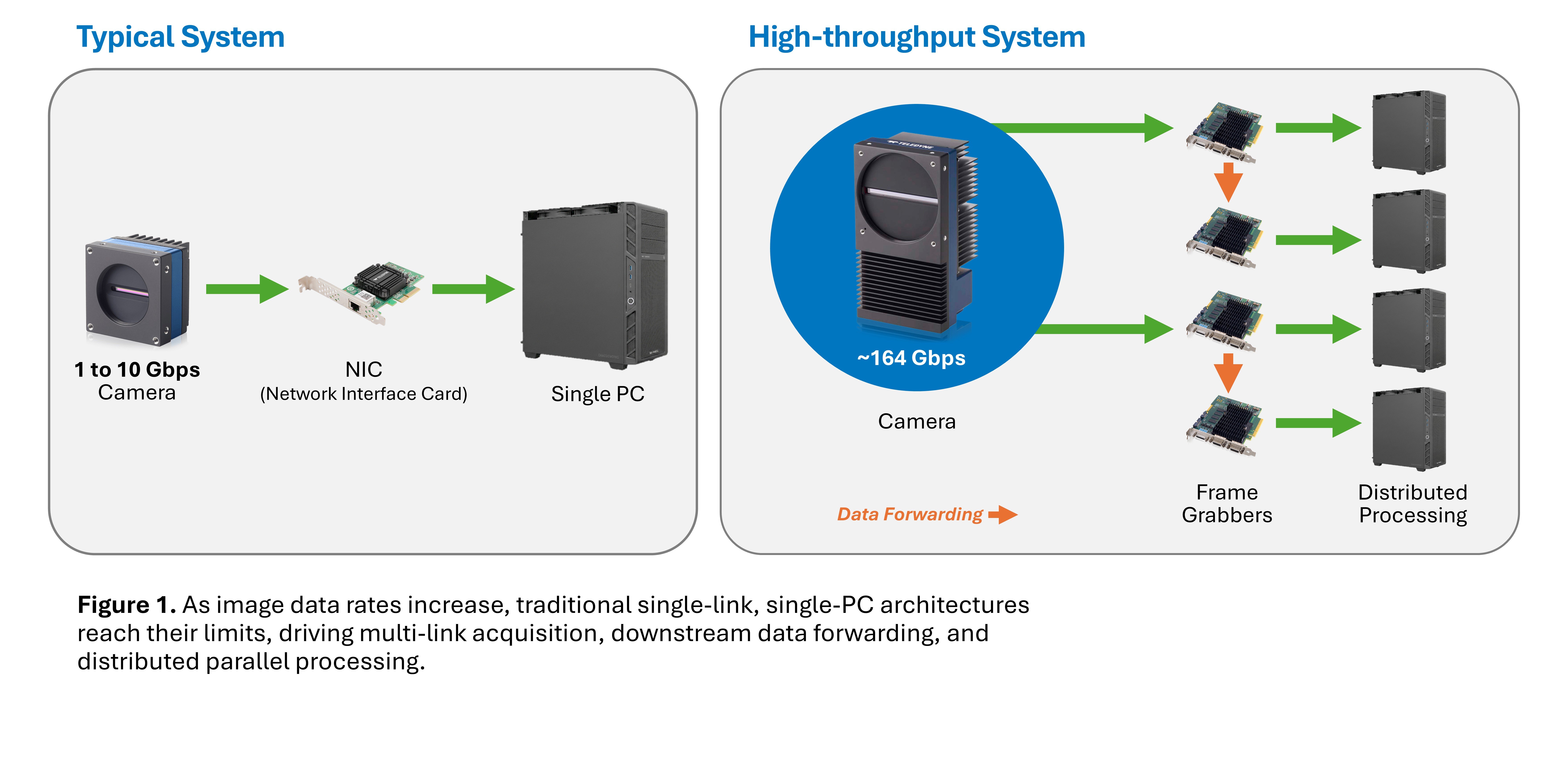
Applications such as glass inspection illustrate the challenge clearly, millions of defects can be detected per scan, yet only a small subset is relevant. Efficient upstream processing must occur before AI defect classification can be applied meaningfully.
Across deployments, three system stress profiles repeatedly emerge:
- High bandwidth - link saturation and pressure on memory bandwidth
- High frame rate / high line rate - burst-related latency and buffer allocation failures
- Large multi‑camera networks - aggregate bandwidth and device timing collisions
These issues are familiar to experienced machine vision solution providers, yet they are often underestimated in the early stages of system design.
Interfaces: Where Stability Matters More Than Peak Numbers
In production environments, it’s not theoretical interface bandwidth but sustained throughput, latency behavior, and error-recovery stability that determine whether a system will operate reliably over time at full speed.
High‑throughput installations increasingly require:
- Multi‑link designs to distribute load across multiple high‑bandwidth connections per camera
- Interfaces such as Camera Link High Speed® (CLHS), CoaXPress® (CXP), or GigE Vision®, evaluated not only for physical-layer determinism but also stable transport-layer and GenTL® behavior
- Driver stacks and GenTL implementations that support diagnostics and data recovery from transient errors, and remain predictable under sustained stress
As interface technologies evolve, whether through higher link speeds, additional lanes, or new physical media, it is often the higher‑level transport behavior, GenTL stability, and diagnostic visibility that determine whether a system remains stable over long production cycles, rather than raw bandwidth alone.
With more than 35 years of driver development experience, Teledyne has focused extensively on transport‑layer behaviors such as jitter, burst recovery, and packet handling that often determine long‑term system stability in high‑throughput applications
This is crucial for machine vision solution providers as factories operating 24/7 frequently encounter intermittent failures that only appear after extended runtime. Unstable interface behavior under borderline conditions is often the hidden cause.
Host Side‑ Processing: The True Throughput Gatekeeper
Even when image transport is stable, the host system itself often becomes the limiting factor. Common challenges include:
- OS-level scheduling delays
- PCIe congestion
- Memory bandwidth bottlenecks
- GPU starvation during bursts processing
Teledyne’s architecture minimizes these risks using in-place data handling, where CPU and GPU share a single buffer and unnecessary memory copies are eliminated. This makes real-time cropping, defect candidate extraction, and AI preprocessing possible with extremely large images.
At the SDK level, this demands more than basic image acquisition. Production systems increasingly require consistent throughput control, scalable multi‑camera organization, real‑time diagnostics, and support for non‑frame‑based image data, such as partial line‑scan outputs, multiple Region‑of‑Interest (ROI) capture, or multi‑view data.
Supporting these requirements at production scale typically demands SDK‑level control where acquisition hardware, transport software, diagnostics, and host‑side processing are designed as a unified system rather than optimized in isolation.
Achieving this degree of cross‑layer coordination across acquisition hardware, transport, diagnostics, and host‑side processing is exceptionally difficult when these elements are developed by separate vendors or treated as interchangeable components.
Why Lab Success Often Fails in the Field
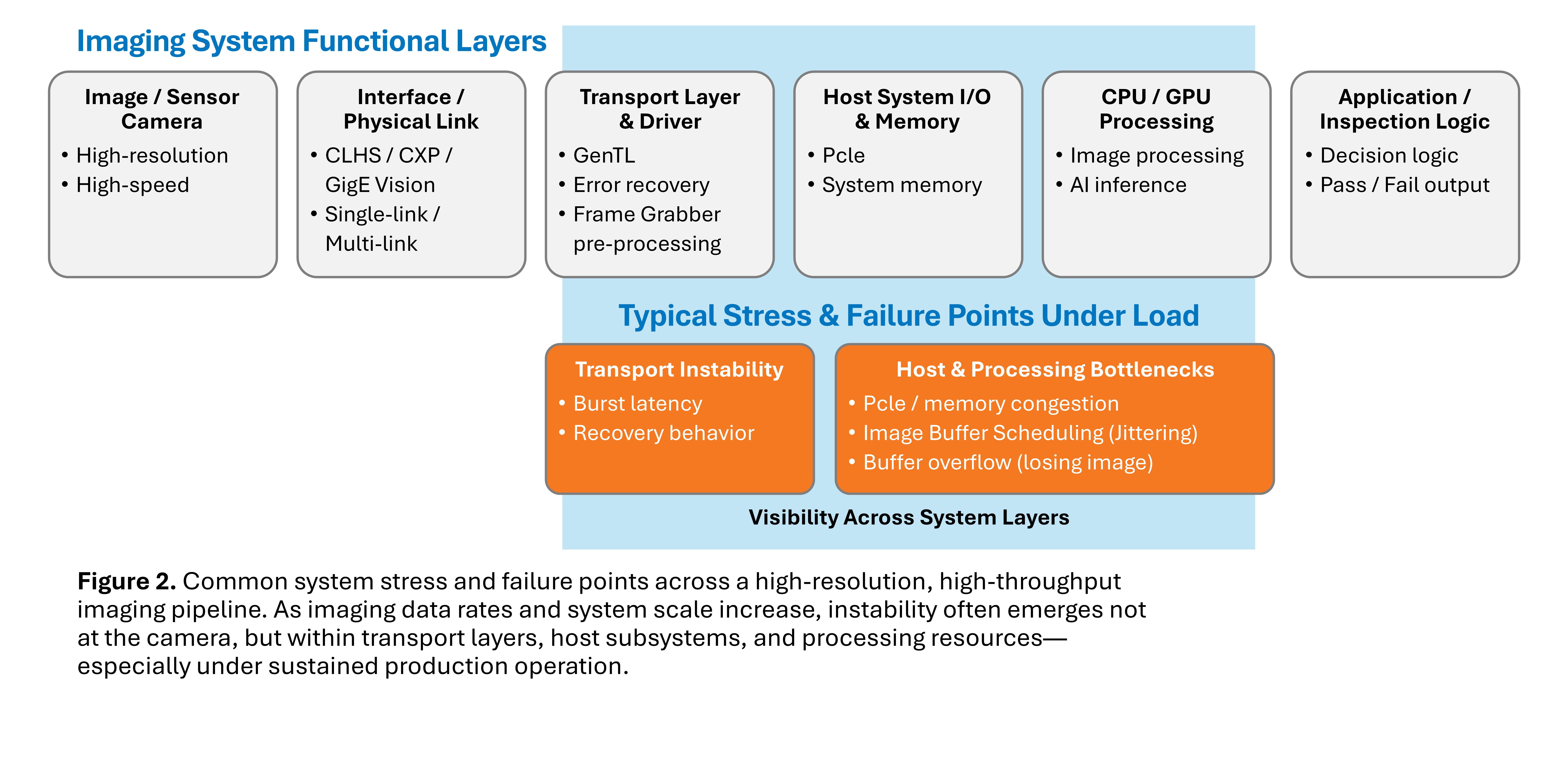
Global deployments systems that pass lab validation, frequently fail just weeks into real production.
Typical causes include:
- Synchronization drift between the cameras and encoders
- Rare but damaging buffer overruns
- Infrequent OS-driven latency spikes
- Traffic congestion as camera counts increase
In production environments, detailed diagnostic observability becomes critical for both cameras and frame grabbers. Teledyne’s integrated T2IR (Trigger to Image Reliability) diagnostic tools within its SDKs are designed to help uncover transport, timing, and bandwidth issues early on, enabling engineers to trace bandwidth usage, identify misbehaving devices, and detect abnormal trigger patterns in real time, capabilities that are essential for minimizing downtime in 24/7 operations.
These diagnostic capabilities reflect requirements repeatedly encountered in long‑running, high‑duty‑cycle production systems, where rare failures can have disproportionate impact on operations.
Practical Architecture Patterns for High Throughput Systems
High speed line scan for continuous materials
Typical for glass, films, paper, and flexible electronics:
- 16K-32K cameras at extreme line rates
- Multi‑link CLHS
- Multi-PC pipelines
- Region of Interest (ROI) extraction followed by AI classification
High-resolution area scan for indexed inspection
Common in metrology, electronics, robotics:
- Burst capture rather than continuous streaming
- Strong emphasis on deterministic triggering and memory handling
Large multi‑camera clusters
Increasingly common in logistics and panel inspection:
- Tens to hundreds of cameras
- Shared bandwidth and timing constraints
- Elevated need for system‑level diagnostics
- Precise multi-camera synchronization such as Precision Time Protocol (PTP)
Conclusion: Building Systems that Scale with Imaging Demands
In today’s high-resolution, high throughput imaging systems, long term stability is determined less by peak component specifications and more by how reliably the entire system behaves under sustained production conditions. Interfaces, transport behavior, host processing, synchronization, and diagnostics must be engineered as a cohesive whole rather than optimized independently.
As imaging architectures grow in data rate and complexity, solution providers are finding that assembling isolated components is no longer enough. Systems designed with full ownership across acquisition hardware, drivers, SDKs, and diagnostics behave very differently under continuous load compared with those built from loosely connected components.
Because Teledyne designs and supplies both cameras and frame grabbers, this system level approach extends from the sensor interface through to acquisition hardware, transport software, and host side‑ processing. For applications requiring extreme throughput, large image volumes, or complex multicamera configurations, this depth of integration is often the difference between short-term validation success and long-term reliable production on the factory floor.