
SCION: SUPR and NDR
SUPR: Sample-Up-The-Ramp
NDR: Non-Destructive Readout
Key Takeaways
- Non-destructive readout (NDR) allows each pixel to be read multiple times during a single exposure, without resetting or disturbing stored charge
- Sample-Up-The-Ramp (SUPR) extracts signal from time, enabling accurate measurements even when pixels saturate
- SUPR reduces effective read noise and extends dynamic range
- SUPR is robust to random telegraph noise (RTN) and cosmic rays, making it well suited for space and radiation-prone environments
- The SCION VISGaAs SWIR camera from Teledyne Scientific Cameras is capable of true SUPR, resulting in low read noise, high dynamic range, and suitability to image in extreme environments
Background
Imaging applications that require long exposure times often face a fundamental challenge: simultaneously capturing faint structures while avoiding saturation of bright features within the same scene. This is particularly common in astronomy, space-based imaging, and other scientific applications where photon flux can vary dramatically across the field of view. Conventional single-sample readout modes force a trade-off between sensitivity and dynamic range, frequently leading to pixel saturation, loss of intensity information, and degraded quantitative accuracy.
Teledyne Scientific Cameras’ SCION SWIR VISGaAs camera uniquely implements true per-pixel Non-Destructive Readout (NDR), enabling Sample-Up-The-Ramp (SUPR) operation with extended dynamic range, reduced effective read noise, and inherent robustness to random telegraph noise (RTN) and radiation-induced events such as cosmic rays.
NDR and SUPR: Concepts and Definitions
NDR refers to the ability to read the signal stored in a pixel multiple times during a single integration period without resetting or discharging the pixel. Each read measures the instantaneous pixel signal while preserving the accumulated charge.
SUPR builds on NDR, performing multiple reads a on a pixel over time, going ‘up the ramp’ as the signal level on that pixel increases, even up to saturation. SUPR typically uses a series of NDR reads acquired at known times during an exposure, where under constant photon flux, the pixel signal increases linearly with time (forming a ramp, as seen in Fig.1). By fitting a line to this sequence of samples, the photon flux is estimated from the slope of the ramp rather than from a single final sample.
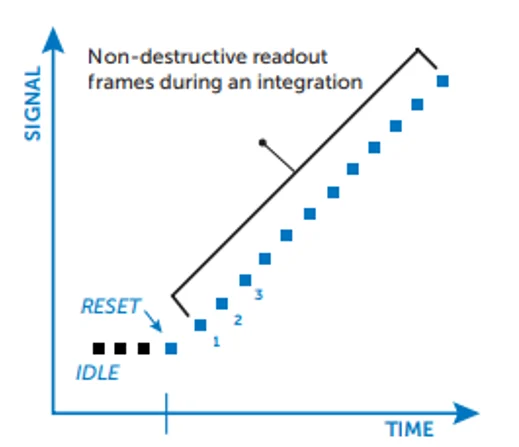
Figure 1: Incremental NDR signal measurements over time during an integration, starting from reset and idle states, and resulting in a ramp (hence sample-up-the-ramp).
The ability to have NDR and perform SUPR is an important consideration for a scientific camera, due to SUPR extracting additional performance and information from NDR data. For more technical details on NDR and SUPR, please refer to the linked publication by Offenberg et al (2005).
True NDR Through CTIAs
The term ‘non-destructive readout’ can be used somewhat loosely, with some sensors exhibiting ‘NDR-like’ behaviour such as source-follower pixels or shared capacitors, which can either perturb the charge on the pixel when reading, or cannot support enough reads for an uninterrupted ramp.
The SCION SWIR VISGaAs camera achieves true NDR through its pixel architecture, which includes capacitive transimpedance amplifiers (CTIAs). CTIAs are in-pixel amplifier configurations that convert photoelectrons of signal directly into a voltage by integrating the current into a capacitor.
The photodiode does not store charge directly and is held at a constant voltage (a virtual ground) which ensures that any signal is integrated exclusively into a feedback capacitor. This virtual ground prevents charge sharing or redistribution during readout, making the pixel response highly linear, and allows for true NDR by effectively decoupling the signal storage from the photodiode itself.
Successful SUPR relies on the critical assumption that the pixel signal increases linearly with time under constant illumination. Only true NDR through CTIA pixel architecture reliably satisfies this condition, allowing for highly linear ramps, no read-induced charge loss, and stability across many reads.
For more technical details on CTIAs, please refer to Appendix One.
SUPR Benefits
With true NDR enabling optimal SUPR performance, what are the benefits involved with this readout format? In SUPR mode, each non-destructive read is stored as a time-ordered sample, forming a per-pixel sequence that can be visualized as a ramp. Across the full sensor, these ramps form a three-dimensional data cube with axes corresponding to x, y, and time (or sample index), as shown in Fig.2.
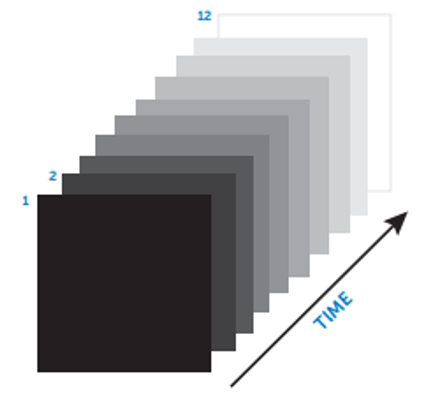
Figure 2: The datacube formed by performing SUPR across a full sensor. The x and y dimensions form the sensor plane, and the z axis is time, as SUPR performs readouts at set times, forming a datacube.
This time-resolved datacube enables advanced processing techniques that are not possible with single-sample readout, including slope fitting, saturation-aware signal estimation, and transient event detection. There are also benefits in read noise reduction and dynamic range extension.
Read Noise Reduction
One of the primary benefits of SUPR is the reduction of effective read noise through repeated sampling. In SUPR, signal is extracted via linear regression rather than simple averaging, but a similar noise reduction behaviour still applies. The improvement is ultimately limited by correlated noise sources, which in turn can be analyzed using the Allan variance to determine the optimal number of samples.
The slope uncertainty is significantly lower than the uncertainty associated with a single read, improving precision. Using the SCION as an example, read noise from a single read is ~30 e-, and read noise from the SUPR mode is <1 e-, allowing for far more sensitive imaging in low-signal applications and environments.
Dynamic Range Extension and Saturation Handling
In conventional readout modes once a pixel saturates, all information about higher photon flux is lost. In SUPR, useful signal information can still be recovered if enough unsaturated reads exist on the ramp before saturation occurs, as seen in Fig.3.
When fitting the ramp, samples acquired after saturation are excluded from the regression. The slope is determined solely from the linear, unsaturated portion of the ramp, allowing accurate estimation of photon flux even when the final samples are saturated. In this way, SUPR effectively extends the dynamic range by encoding signal information in time rather than relying solely on charge capacity.
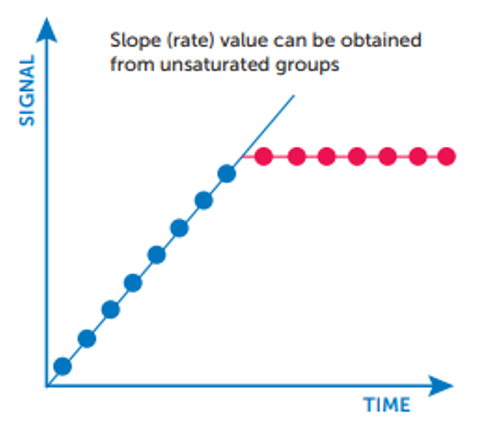
Figure 3: SUPR, saturation and extended dynamic range. NDR reads are carried out as signal increases (blue) until the pixel is saturated (red). The blue points form a ramp that can be extrapolated to estimate the signal accumulation rate beyond saturation, extending the dynamic range.
Mitigation of Random Telegraph Noise, Cosmic Rays, and Radiation-Induced Events
Random Telegraph Noise (RTN) manifests as discrete, step-like changes in pixel offset over time. Similarly, cosmic rays and other radiation events can introduce sudden jumps in the accumulated signal. In a SUPR ramp, these effects appear as abrupt outliers that divide the ramp into distinct segments.
Because SUPR estimates signal from the slope of the ramp rather than from absolute voltage levels, step changes induced by RTN or cosmic rays have minimal impact on the fitted slope. In the case of a cosmic ray event, the ramp can be segmented and the slope estimated from unaffected samples, preserving the underlying photon flux measurement. This inherent robustness makes SUPR particularly well suited for space and radiation-prone environments.
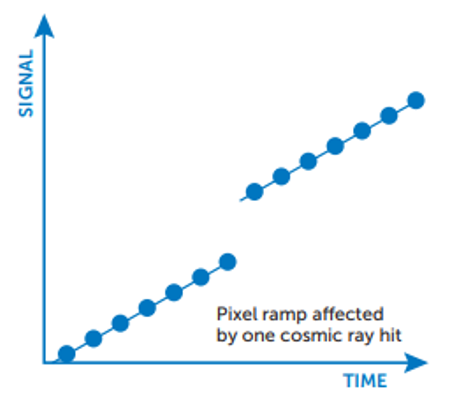
Figure 4: SUPR and RTN or cosmic rays. SUPR reads out pixel signal until a cosmic ray hit causes a jump in accumulated signal, after which the ramp continues as normal. By segmenting the ramp the original signal accumulation rate can still be calculated, unaffected by the cosmic ray.
True NDR and SUPR in the SCION VISGaAs Camera
The Teledyne Scientific Cameras’ SCION VISGaAs SWIR camera is uniquely designed to support true NDR and SUPR operation through its per-pixel CTIA architecture. SCION is currently the only camera platform offering these capabilities as standard operating modes.
Key Benefits
- Extended dynamic range for scenes containing both bright and faint features
- Reduced effective read noise through multi-sample slope fitting
- Improved quantitative accuracy for long integration times
- Robustness to RTN and cosmic ray events
- Time-resolved pixel data enabling advanced post-processing
Typical Applications
- Astronomical imaging of stellar fields and extended objects
- Space situational awareness and surveillance
- Earth observation with high-contrast scenes
- Scientific and laboratory imaging requiring long exposures
- Spectroscopy and other photon-limited measurements
Operational Considerations
SUPR operation introduces trade-offs between the number of samples, data volume, and processing complexity. Optimal performance depends on selecting an appropriate sampling cadence and number of reads based on the dominant noise sources and application requirements. Slope extraction may be performed in post-processing or integrated into downstream data pipelines.
Read Noise vs Speed
SUPR mode can reduce effective read noise, which is done at the cost of speed (the greater the number of SUPR samples, the lower the effective read noise, and the lower the speed). The trade-off between effective read noise and imaging speed when using SUPR can be seen in Fig.5.
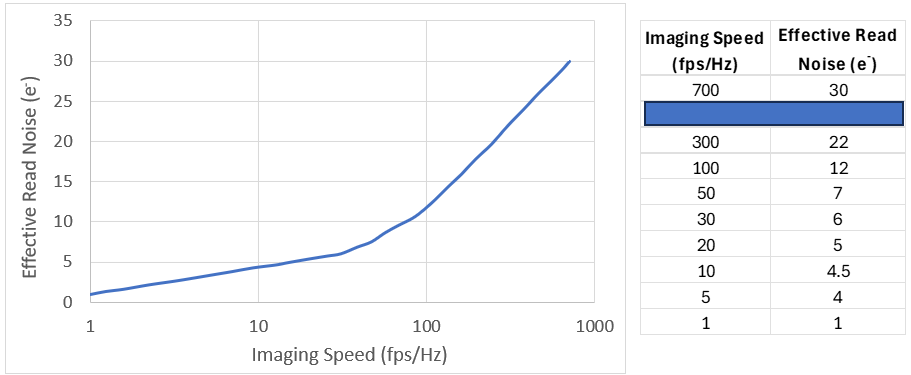
Figure 5: Read noise vs speed in SUPR mode. Here we see provisional data from SCION comparing the imaging speed at different read noise levels, on the left with a graph (logarithmic x-axis scale) and on the right with a table of values. Values subject to change on official release.
Image File Size
As shown in Fig.2, when using SUPR mode a data cube is generated (X and Y being the camera sensor and Z being time). The SCION can achieve 700 fps at full frame, meaning SUPR mode can involve capturing up to 700 frames of data, rather than one single frame in a standard mode. This can result in larger file sizes when using SUPR.
SCION images are acquired in 16-bit across a 640 x 512 sensor, in standard mode each acquired frame is 0.6 MB in size. Full SUPR sampling would result in files up to 700 times larger, up to 420 MB. There are no issues with data transfer (SCION’s USB 3.2 cables have a minimum data rate of 5 Gbps or 625 MB/s), but be aware that enabling SUPR mode will result in larger file sizes, especially if running long experiments or time lapses.
Conclusion
The CTIA-based VISGaAs architecture of the Teledyne SCION camera enables true non-destructive pixel readout, providing the foundation for SUPR operation. By capturing a sequence of non-destructive samples and extracting signal information from the ramp slope, SUPR extends dynamic range, reduces effective read noise, and mitigates the impact of RTN and radiation-induced artifacts. These capabilities make SUPR and NDR powerful tools for demanding imaging applications requiring long exposure times, high dynamic range, and robust signal integrity, and position SCION as a uniquely capable camera platform in this space.
References
Offenberg, J. D., Fixsen, D. J., & Mather, J. C. (2005). Memory-Efficient Up-the-Ramp Processing with Cosmic-Ray Rejection. Publications of the Astronomical Society of the Pacific, 117(827), 94-103. https://doi.org/10.1086/427566
Appendix One: CTIA Details
In the SCION there are CTIAs integrated into each pixel. With the CTIA, the photocurrent is integrated exclusively onto a feedback capacitor, Cf. At the beginning of an exposure, a reset switch momentarily shorts Cf, setting the output voltage to a known baseline. Once the reset is released, the photocurrent integrates onto the capacitor, producing an output voltage given by:
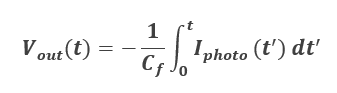
Because the CTIA amplifier draws negligible input current, reading the pixel does not discharge the capacitor. Each read therefore samples the instantaneous output voltage Vout (ti) without disturbing the stored charge. Repeated reads at times t1, t2,... ,tn produce a ramp whose slope is proportional to the incident photocurrent:
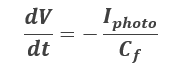
This architecture contrasts with conventional source-follower pixels, where readout inherently perturbs the stored charge and prevents true non-destructive sampling. An example of CTIA pixel architecture can be seen in Fig.6.

Figure 6: A diagram of the CTIA pixel architecture found in true NDR capable cameras such as the SCION VISGaAs from Teledyne Scientific Cameras.