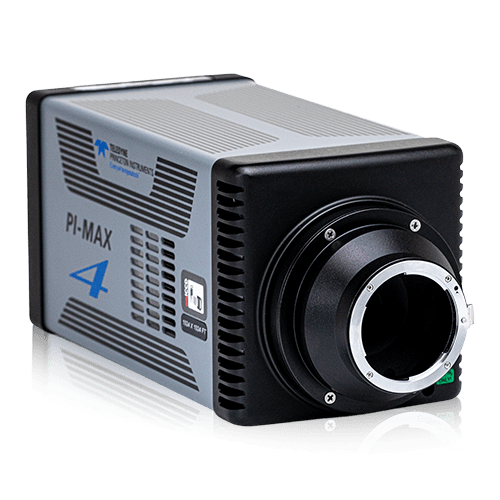
Ultrafast Plasma Dynamics with ICCDs
Dr. Milan Šimek, Head of Opto‑Electrical Plasma Diagnostics Group, Institute of Plasma Physics, Czech Academy of Sciences (IPP CAS), Prague, Czechia
Background
At the Institute of Plasma Physics of the Czech Academy of Sciences, Dr. Milan Šimek leads the optoelectrical plasma diagnostics group. “We focus on plasmas produced by short high‑voltage pulses of nanosecond duration. One research branch is related to plasmas produced in gases, typically nitrogen, oxygen, or hydrocarbon gases while the other line of research focuses on plasmas produced with water” Dr. Šimek mentions. In a recently published work (Fujera et al. 2025), his team investigated transient streamer‑spark discharges at the air–water interface to enable sustainable method for nitrogen fixation and plasma‑activated water (PAW) production. “When you produce plasmas in or in contact with water, you can fix nitrogen in solution in such a way that it can be used by plants as fertilizer”, referring to one of the direct applications of plasmas produced in water.
Using time-resolved ICCD imaging and optical emission spectroscopy, Dr. Šimek’s group demonstrated that the discharge begins as cold streamers before rapidly transitioning into transient sparks, with gas temperatures soaring to nearly 1000 K. This shift in temperature dramatically accelerates the dissociation enhances the dissociation of N₂ and O₂ and the transfer of reactive species into the liquid phase. Consequently, this process enables effective nitrate enrichment of water (NO₃⁻ production rates up to ~48.5 µmol min⁻¹ with energy efficiencies around 16 mmol MJ⁻¹) under ambient conditions, while also imparting measurable antifungal activity. Notably, a major advantage of this localized process is its minimal footprint: it requires only atmospheric nitrogen, oxygen, and electricity, which can in principle be sourced entirely from renewable energy. “This is exactly the chemical form which can be used by plants. [...] It could offer a green alternative to traditional manufacturing methods, which are rooted in heavy chemical industry” states Dr. Šimek.
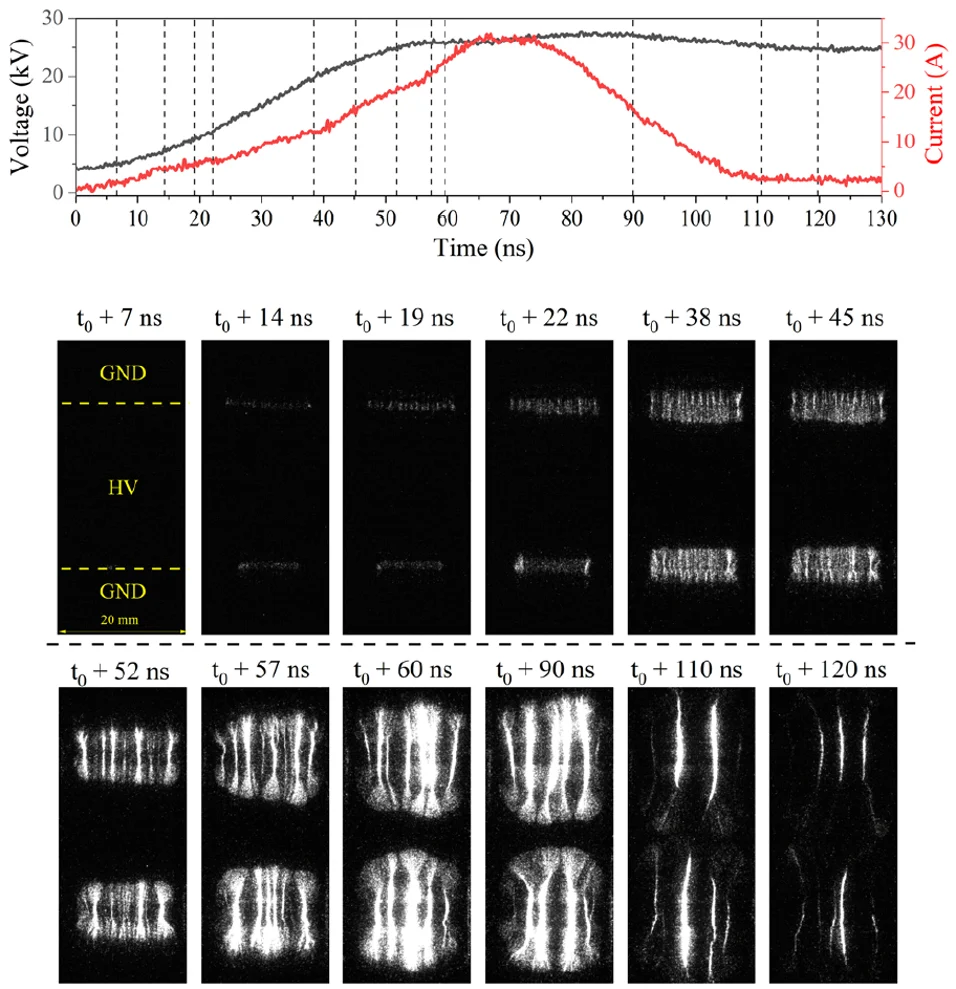
Figure 1: PI-MAX ICCD image sequence (top view) visualizing the evolution of the discharge along the voltage and current waveform. Yellow broken lines in the first image indicate the positions of the blades. The dashed lines in the UI waveform correspond to the times in the image sequence. Taken from Fujera et al. 2025.
Challenge
While imaging and emission spectroscopy are well-established techniques, they face substantial limitations when studying ultrafast processes. Dr. Šimek states: “Because we are dealing with transient plasmas of nanosecond duration, we require time resolutions in the order of a few nanoseconds, ideally even sub‑nanosecond.” Capturing the low signal intensities inherent to such brief exposure widows requires highly sensitive detection systems, equipped with gating capabilities fast enough to match the required time resolution. Furthermore, sensor geometry must align with the specific application, while spectroscopy utilizes elongated, rectangular detectors to maximize spectral coverage, optical imaging requires a square sensor format to optimize the two-dimensional field of view.
The advantage of PI-MAX is that it couples a large ICCD sensor with nanosecond gating, providing an ideal solution for capturing fast-evolving transient events [...] we were quite satisfied.
Dr. Milan Šimek
Solution
The PI-Max family is an intensified and gated imaging platform which perfectly matches the challenging requirements of this experimental setup. Dr. Šimek’s group takes advantage of the 1024 × 1024-pixel interline-transfer CCD’s surface to acquire images (see figure 1) with ultra-fast gate widths down to 0.5 ns. As he notes: “To understand the morphology of the discharge, you need to take ultra‑fast images [...] That is why we use PI-MAX ICCD to capture images or emission spectra resolved in time. ICCD images with short gates allowed us to visualize the very beginning of the discharge and its subsequent evolution. By doing a sequence of images in time, we discovered that the discharge evolves from initially a streamer into a spark regime after a few tens of nanoseconds transition.”
As demonstrated in this note, the gating capability of the PIMAX ICCD enabled to investigate ultrafast processes and offer gated solutions for spectroscopy but also for imaging applications, a feature that is not available on every ICCD.
Reference
Fujera, J., Hoffer, P., Prukner, V., Rotondo, P. R., Arora, G., Jirásek, V., De Miccolis Angelini, R. M., Lukeš, P., & Šimek, M. (2025). Streamer-spark discharge at the water surface as a source of plasma-activated water: nitrogen fixation yields and biocidal efficiency. Green Chemistry, 27(27), 8203–8215. https://doi.org/10.1039/d5gc01343g