Nanomaterial Spectroscopy with Single-Molecule Microscopy
Prof. Klas Lindfors
Nano-Optics Group, Institute for Light and Matter, Department of Chemistry and Biochemistry, University of Cologne
Background
Professor Klas Lindfors of the University of Cologne is particularly interested in using plasmonic nanostructures to enhance light-matter interactions, aiming to develop structures and materials with tailored optical properties. Prof. Lindfors explained further, “We are working on nanoscale optics, using light to understand nanostructured materials mainly though transmission, reflection and scattering spectroscopy. Over the years we have also started combining this with single-molecule microscopy as well as photoluminescence and Raman spectroscopy. We can make nanostructured materials with lithography or other nanofabrication tools, and then we aim to figure out the plasmonic structure for the reflection, transmission or scattering spectrum.”
“We combine spectroscopy with microscopy using our microspectroscopy systems, these are mostly custom developed in-house, with various flipping elements so we can have different experimental channels, such as flipping between spectroscopy and single-molecule imaging.”
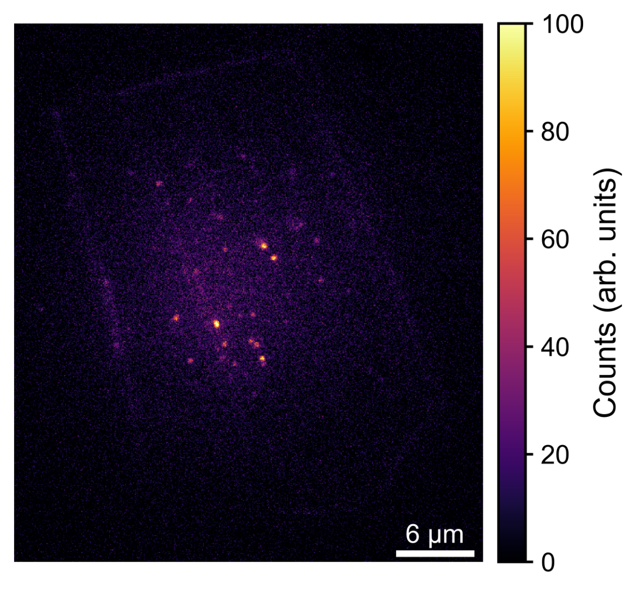
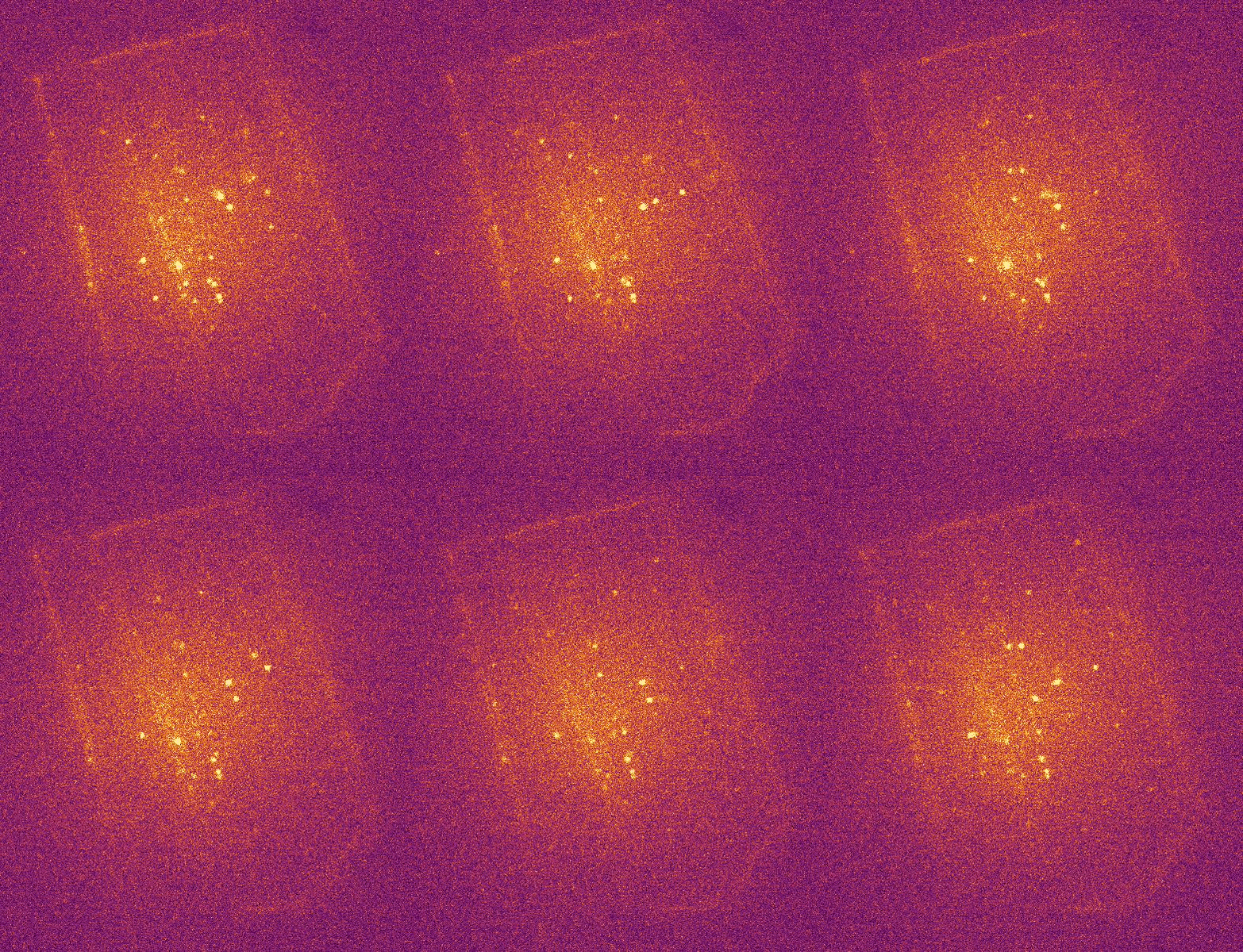 Figure 1: Top shows a photoluminescence image of molecules under hexagonal boron nitride with an intensity scale, and the below video illustrates the dynamics of the same system.
Challenge
Prof. Lindfors described what challenges he faces in his research, “The overall challenge is all about signal-to-noise, some of these systems are not very emissive and bleach quickly. We also have very weakly scattering plasmonic structures and as we illuminate with intense broadband light there is a lot of background, and we need to detect the weak signals through that. Our samples aren’t moving so we can integrate for longer, but in general signal is the typical challenge.”
Detectors and spectroscopy systems that maximize sensitivity while minimizing noise are paramount for this research, to learn more about 2D nanostructures.
In addition, for the imaging and microscopy equipment it is vital to have high speed detectors to image rapid emissions from single molecules embedded in stacks of 2D materials. Prof. Lindfors aims to characterise how the material environment influences the emission signal, looking for bleaching, blinking, orientation, diffusion and more, all of which requires a highly sensitive and fast imaging system.
IsoPlane spectrometers are very convenient for high-resolution imaging spectroscopy across more than 10 years now… our new Kinetix camera has a very, very high frame rate with great signal to noise, we are very happy with all our equipment from Teledyne.
Prof. Klas Lindfors
Solution
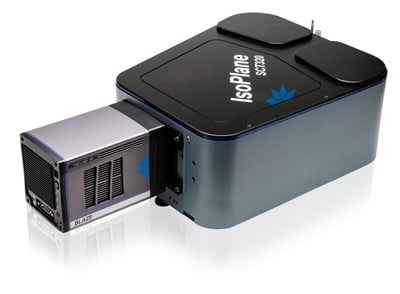
Prof. Lindfors has made use of Teledyne Princeton Instruments’ spectrometers and CCD detectors for over a decade, “We have IsoPlane spectrometers which are very convenient for high-resolution imaging spectroscopy, which saves a lot of time. We can essentially use the IsoPlane as a kind of camera, going to zero order and using the silver mirror instead of a grating, then we can capture images and flip over to take spectra from selection locations and so on… we’ve had some of our IsoPlanes for more than 10 years now, they’ve produced a lot of data over the years and they are still working great.”
For the single-molecule imaging experiments Prof. Lindfors also uses Teledyne Photometrics sCMOS cameras, “We also have a commercial microscope with a Kinetix sCMOS camera. The Kinetix has a high readout rate, so we can get very, very high frame rates to look at blinking across a wide field. We used to have point detectors, but now we can do this imaging across a very large field of view and capture 100 molecules at a time, seeing how they blink with time resolutions of some 10s of milliseconds. This system is very nice, and with a great signal-to-noise… [Kinetix] setup was extremely smooth, it was just plug and play, as easy as it can get. We unpacked, checked the quick start instructions and then we had data coming in, it was very low effort.”
“We use the IsoPlane for taking spectra, and the Kinetix system for single-molecule microscopy, and we can flip between them. For the spectroscopy system we use LightField with a Python interface, where we can turn the polariser at 10 degree angles and collect five spectra or so, then change something else, it’s all very smooth.”
“We’re very happy with all the equipment from Teledyne, and have been a faithful customer for many years, satisfied with the service and the product.”