Nanoscale Mineral Reactivity Under Confinement
Dr. Joanna Dziadkowiec, Dr. Viktoria Trautner
Njord Centre for Studies of the Physics of the Earth, University of Oslo, Norway
Background
Dr. Joanna Dziadkowiec’s research team examines surface and interfacial processes in geological porous media. Her group investigates nanoscale interactions at individual mineral-grain contacts, with particular emphasis on how fluid chemistry, mineral dissolution and precipitation, crystallization, and fluid-driven mechanical deformation influence the properties of porous materials. “We are a geoscience group that studies geological processes in porous media at the nanoscale, particularly at single-grain contacts and interfaces. We are interested in how fluids percolating in porous media drive mineral reactions under spatial confinement and how these reactions cause deformation of rocks and alter their mechanical properties. This work is directly relevant to geological carbon storage: geoengineers inject CO2-rich fluids into porous media, expecting abundant mineral reactions and CO2 mineralization. However, little is known how such geoengineered mineralization will influence the microstructure, porosity, and permeability in host reservoir rocks. Our goal is to investigate relevant mineral reactions at the nanoscale and quantify the forces exerted by mineral reactions to predict changes in cohesion, possible fracturing, and changes to mechanical integrity of the porous media."
“We use a surface force apparatus (SFA), which is in principle similar to an atomic force microscope but is designed to measure interactions between two well-defined macroscopic surfaces rather than between a sharp tip and a sample. These surfaces can be brought into controlled contact under a prescribed applied load, reproducing geometrical confinement experienced by mineral grains at fluid-filled grain boundaries. By repeatedly cycling the reactive mineral surfaces through contact and separation, we measure the interaction forces as a function of their separation distance. These force-distance measurements can be used to understand how fluid-driven mineral reactions may alter the adhesion, friction, and mechanical behaviour at dynamically changing grain contacts."
“Our interacting mineral surfaces typically consist of very thin mineral films. We characterize them using SFA-coupled white light interferometry: light transmitted through and reflected between two semi-transparent mineral films is collected and directed to a spectrograph, which disperses the signal into interference fringes of equal chromatic order (FECO). Analysis of these fringes provides precise measurements of the thickness of the films and surface separation between opposing mineral surfaces. Any changes in the optical response can indicate changes at the mineral interfaces, for example, the nucleation and growth of minerals driven by equilibration with the nanoconfined fluid film in between.”
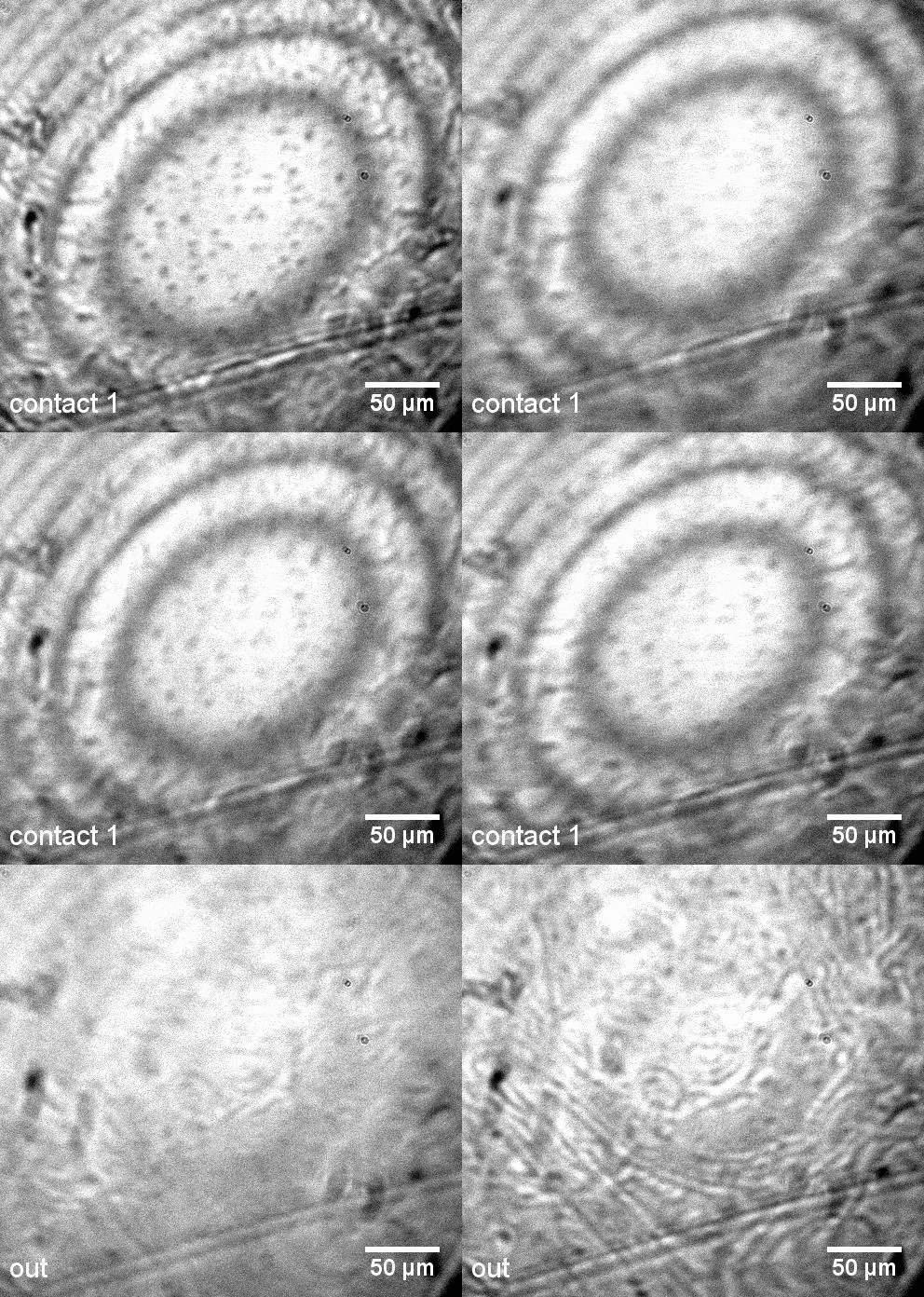
Figure 1: Using a surface force apparatus (SFA) to interrogate nanoscale mineral reactivity under confinement, showing characteristics during contact between two macroscopic surfaces (contact 1) and without load (out). Acquired with the IsoPlane spectrometer and PIXIS CCD camera.
Challenge
Measuring subtle changes in thin and reactive mineral films is technically demanding and requires highly precise optical measurements. As Dr. Dziadkowiec explains, “Surface force measurements require exceptional precision because we need to determine the thickness of the mineral films and the thickness of the confined fluid and track how these evolve over time. We have to understand how the change observed in the interferometric signal reflect mineral growth and dissolution reactions, which in our setup, are usually only limited from a few nanometres to micrometres."
“We also need a broad spectral range. This is essential because the more fringes we produce, the easier it is to resolve changes in film thickness and surface separation. Low optical distortion, especially near the edges of the spectral range, is equally important, since distortion complicates wavelength calibration and fitting of the wavelength positions to our optical model. The mineral surfaces are often rough, and the resulting interferometric signals are typically quite noisy. Therefore, the higher spectral resolution helps us to obtain meaningful data even despite significant broadening of the interferometric fringes and lets us perform accurate measurements of nanoscale mineral growth.”
Postdoctoral researcher Dr. Viktoria Trautner also described the challenges of their work: “We aim to monitor interfacial reactions in real time using the spectrometer setup. To capture these processes without compromising optical signal resolution, we always work at the shortest possible acquisition time that allows us to still get a good interferometric signal. We typically acquire spectra at least once per second, and in some experiments, every 500 milliseconds. Access to a few diffraction gratings is also useful, as it allows us to optimise the spectral range and the number of fringes produced, depending on the thickness of the mineral material.”
We are happy with how [the IsoPlane] works, the spectrometer runs flawlessly, and the system is intuitive to use with the [LightField] software.
Dr. Joanna Dziadkowiec
Solution
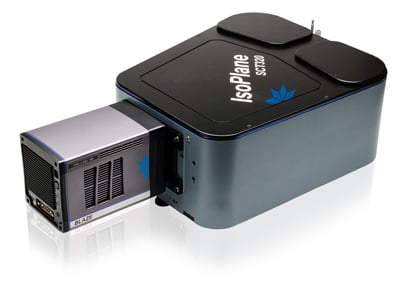
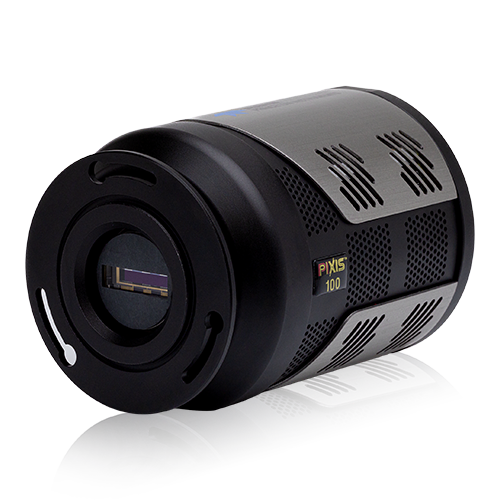
The winning combination of IsoPlane spectrometer, PIXIS CCD detector and LightField software make an ideal system for this challenging application. The astigmatism-free design of the IsoPlane results in very high spectral resolution and sensitivity to the weakest signals, when paired with the PIXIS CCD it can easily determine small changes in the thickness of reactive mineral films.
Dr. Dziadkowiec described her experience with their spectroscopy system, “We are happy with how the system works, the spectrometer runs flawlessly, and we are interested in expanding our setup to include other complementary techniques and forms of spectroscopy in the future, such as Raman spectroscopy.”
Dr. Trautner also commented, “I have not worked with anything similar before, but the system and the software are intuitive to use, which allowed me to quickly become independent in running experiments.”
References
Trautner, V., Rogowska, M., Plümper, O., Nilsen, O., and Dziadkowiec, J. (2026) How hard do crystals push when growing under confinement? Real-time measurements of surface forces during hydration of periclase to brucite, EGU General Assembly 2026, Vienna, Austria, 3–8 May 2026, EGU26-7493, https://doi.org/10.5194/egusphere-egu26-7493
Dziadkowiec, J., & Ro Yne, A. (2020). Nanoscale Forces between Basal Mica Surfaces in Dicarboxylic Acid Solutions: Implications for Clay Aggregation in the Presence of Soluble Organic Acids. Langmuir : the ACS journal of surfaces and colloids, 36(49), 14978–14990. https://doi.org/10.1021/acs.langmuir.0c02290
Dziadkowiec, J., Zareeipolgardani, B., Dysthe, D. K., & Røyne, A. (2019). Nucleation in confinement generates long-range repulsion between rough calcite surfaces. Scientific reports, 9(1), 8948. https://doi.org/10.1038/s41598-019-45163-6