Broadband Photoluminescence Material Spectroscopy
Prof. Tobias Korn
2D Crystals and Heterostructures Group, Institute For Physics, University Of Rostock, germany
Background
The group of Prof. Tobias Korn at the University of Rostock are focused on the optical and excitonic properties of two-dimensional (2D) materials. The group uses deterministic transfer processes to produce crystals/heterostructures and characterizes them using photoluminescence and Raman spectroscopy, studying their properties and interlayer interactions.
One recent project (led by Prof. Korn's PhD student Johannes Schwandt-Krause) focuses on ferroelectric domains in rhombohedral molybdenum difsulphide (MoS₂) 3R crystals, and their impact on interlayer excitons in van der Waals heterostructures. In a recent publication in Nano Letters: 'Ferroelectric Control of Interlayer Excitons in 3R-MoS2/MoSe2 Heterostructures'
(Schwandt-Krause et al. 2026) Prof. Korn's group provide experimental evidence of interlayer excitons controlled by ferroelectric properties, demonstrating how polarization domains shape exciton energies with high spatial precision.
Using photoluminescence spectroscopy on 2D heterostructures, the emissions of MoSe₂, MoS₂ and interlayer excitons can be distinguished and characterized (as shown in Fig. 1). This fundamental research could potentially find applications in providing an alternative semiconductor material and add novel functionality to electronic devices. as Mr Schwandt-Krause mentioned, to us, “for example, you could imagine novel ferroelectric field effect or even excitonic transistors”.
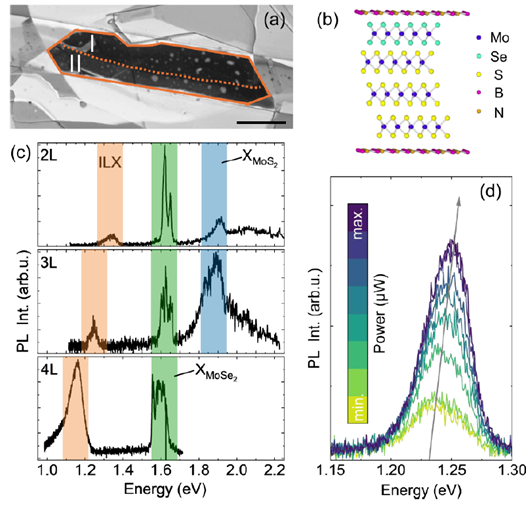
Figure 1: (a) Optical image of an hBN-encapsulated nL- MoS₂/ MoSe₂ heterostructures on gold contacts. The heterostructure is divided into a region with 3L- MoS₂ (I) and a region with 4L- MoS₂ (II), indicated by the orange lines. The black scale bar corresponds to 10 μm. (b) Schematic of the hBN-encapsulated 3L- MoS₂/ MoSe₂ heterostructure, highlighting the 3R stacking of MoS₂. (c) PL signals of different MoS₂/ MoSe₂ heterostructures with 2L/3L/4L- MoS₂ from top to bottom. The green and blue areas indicate the intralayer excitons of MoSe₂ and MoS₂, respectively. The salmon-colored area shows the ILX signal of the heterostructures. While the 2L and 3L spectra were recorded using a Si CCD, the 4L spectrum was measured using an InGaAs photodiode array. (d) Power dependence of the PL signal in region I of panel (a). The gray arrow indicates a blueshift in the signal with increasing power. Figure taken from Schwandt-Krause et al 2026.
Challenge
The structures investigated by Prof. Korn's team are manually produced, often only a few microns in size, and thereby variable in their properties. Mr. Schwandt-Krause mentions that each sample is “its own snowflake” and requires detailed spectroscopic mapping to reveal local variations in layer coupling, ferroelectric domains, and interlayer excitons.
Prof. Korn states, “The big challenge we had there is the difference in emission energies that we have in our samples. We have excitons which live in one material and emit in the visible to near infrared. At the interface between two different materials, so-called interlayer excitons can form, and they typically have lower energies, on the order of 1200 meV.” (corresponding to ~1033 nm emissions).
It is a challenge to perform broadband high-resolution photoluminescence spectroscopy on fragile, hand-built 2D heterostructures, and to both capture emissions from the intralayer excitons in MoSe₂ and MoS₂ (1.6-1.8 eV) as well as the interlayer excitons (ILX) (1.2 eV), different detectors are necessary. High sensitivity was also required along with other optical challenges such as etaloning, meaning a specific solution would perform best for this experimental setup.
“Our work relies on detecting excitons across a broad spectral range. With the PIXIS and PyLoN on the same spectrometer, we can switch between spectral regions instantly. The stability is excellent, even 72 hour scans run flawlessly, and thanks to LightField’s integration in LabVIEW automated mapping and gated measurements are straightforward. This setup truly enables the experiments we need.”
Prof. Tobias Korn
Solution
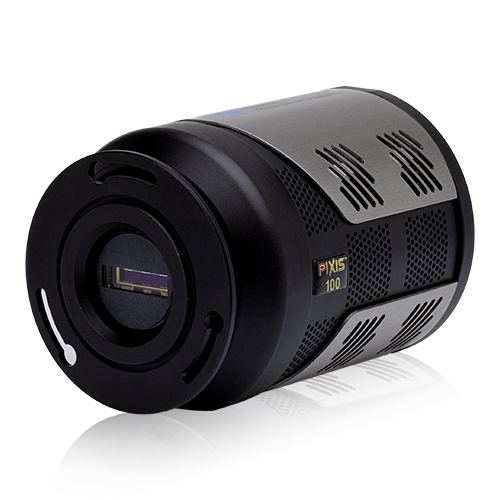
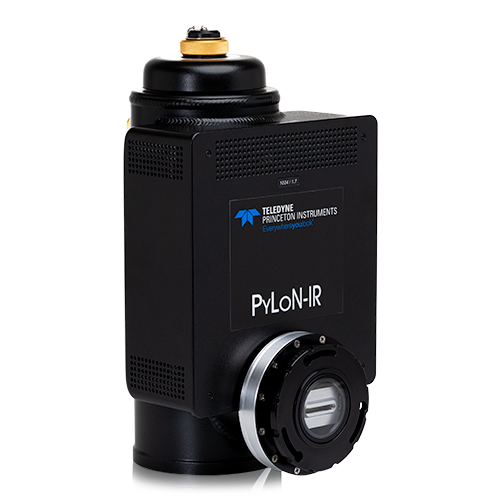
To overcome the challenges with spectral coverage, Prof. Korn combines a Princeton Instruments SP 2300i spectrograph with dual-detector solutions from Teledyne Princeton Instruments: the PIXIS 256e CCD for high sensitivity detection from the the visible to NIR, and the PyLoN-IR InGaAs array for spectroscopy in the extended SWIR region.
Prof. Korn commented on his system, “The cool thing is we just flip the mirror and either have the high quantum efficiency in the visible/NIR with the PIXIS or in the further infrared region with the PyLoN.” The entire system can be controlled with Teledyne Princeton Instruments' Lightfield software, simplifying installation, calibration and operation of the system as much as possible. The sensitive cameras used provide spectral information demonstrating interlayer excitons being controlled by ferroelectric properties, as demonstrated in the publication referenced here, and allows Prof. Korn to gain more insight into the optical and excitonic properties of 2D materials and van der Waals heterostructures.
Reference