Reflection and Transmission Spectra of Hafnium Nitride Nanocavities
Beyza Nur Günaydin, Süleyman Çelik, Selim Tanrıseven, Ali Osman Çetinkaya, Fevzi Çakmak Cebeci, Meral Yüce, and Hasan Kurt
SUNUM Nanotechnology Research and Application Centre, Sabanci University, Istanbul, Turkey
Background
Plasmonic nanostructures exploit the collective oscillation of free electrons at a metal surface to concentrate and manipulate light at the nanoscale, enabling extraordinarily sensitive detection of changes in the surrounding refractive index. This makes plasmonic nanostructures highly attractive for biosensing applications, where shifts in the plasmonic resonance wavelength can report on the presence of molecules, pathogens, or biological analytes in real time and without labels. The field has long been dominated by gold and silver, which offer strong plasmonic responses but suffer from poor mechanical robustness, limited thermal stability, and incompatibility with CMOS semiconductor fabrication processes.
Refractory transition metal nitrides, particularly titanium nitride (TiN) and hafnium nitride (HfN), have emerged as compelling alternatives. HfN is mechanically hard, chemically stable, thermally resilient, and fully CMOS-compatible, making it attractive for integrated photonic and biosensing platforms. Crucially, its optical properties (including the balance between free-carrier concentration and optical losses) can be tuned during deposition by adjusting the reactive sputtering gas ratio and substrate temperature.
Researchers at Sabanci University (Istanbul, Turkey) and Imperial College London (London, UK) set out to systematically optimise HfN thin film deposition by reactive radio frequency (RF) magnetron sputtering, exploiting the resulting films for the fabrication of two classes of periodic plasmonic nanostructure: nanocavity arrays (support grating-coupled surface plasmon polaritons (SPP)) and nanodisk arrays (generate surface lattice resonances, (SLR)). They also aim to characterise the refractometric sensing performance of HfN nanocavity and nanodisc arrays across a range of surrounding medium refractive indices in the visible to near-infrared.
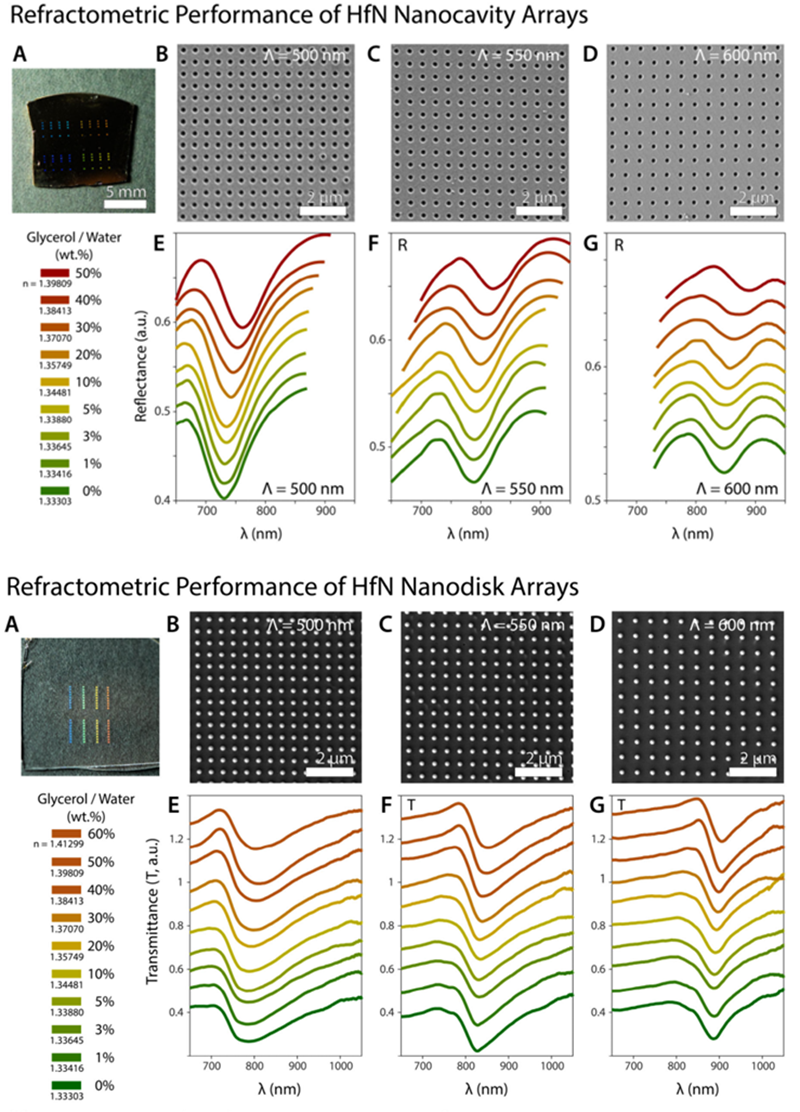
Figure 1: Refractometric performance of HfN nanocavity (top) and nanodisk (bottom) arrays. A) Photograph of nanofabricated HfN arrays with varying periods. B/C/D) SEM micrograph of HfN arrays across varying periods. E/F/G) Refractive indicies of the surrounding medium, with refractive index sensitivities investigated. Adapted from Günaydin et al. 2025.
Challenge
The central spectroscopic challenge of this study was acquiring high-fidelity reflectance and transmittance spectra from nanoscale periodic arrays (each with an active area of only 200 × 200 µm) as a function of the refractive index of the surrounding medium. This needs to be done with sufficiently high spectral resolution and signal-to-noise in order to reliably track sub-nanometer shifts in plasmonic resonance wavelengths. These resonance shifts serve as the readout for refractometric sensitivity, and the ability to distinguish and quantify them accurately is the direct determinant of measured sensing performance.
For the HfN nanodisk arrays in particular, the surface lattice resonance (SLR) features arise from coupling between localised surface plasmon resonances and diffractive orders. These can exhibit extremely narrow spectral line widths, in this study reaching as little as 15 nm full width at half maximum for the 600 nm period HfN nanodisk arrays. Resolving and accurately measuring such narrow features requires a spectrometer and detector combination with both high spectral resolution and excellent sensitivity, particularly given that the excitation light must be efficiently delivered to and collected from a sub-millimetre active area. Furthermore, quantitative refractometric sensing requires well-calibrated absolute wavelength and intensity scales across the full Vis–NIR measurement range, as any systematic wavelength error would directly corrupt the sensitivity calculations on which the study's conclusions rest.
Solution
The ideal solution for this challenging research was a combination of Teledyne Princeton Instruments' IsoPlane 320 spectrograph with the ProEM-HS EMCCD camera. Spectral measurements were performed using a custom reflection and transmission microspectroscopy setup, using the astigmatism-free Schmidt–Czerny–Turner design of the IsoPlane, this optical design ensured that spectral features were accurately mapped across the full detector area without spatial blurring, which is critical when the input is focused through a 10 µm spectrometer slit from a small-area plasmonic array. The ProEM's back-illuminated sensor architecture provided the high quantum efficiency needed to detect the weak reflectance and transmittance signals from the 200 × 200 µm nanopattern areas with excellent signal-to-noise across the full Vis–NIR measurement range.
Wavelength and intensity calibration of the microspectroscopy system were performed using the Princeton Instruments IntelliCal system, employing Hg and Ar/Ne lamps for wavelength calibration and a NIST-traceable LED-based source for intensity calibration. This rigorous two-axis calibration was essential for the quantitative accuracy of the refractometric sensitivity measurements, ensuring that the resonance wavelength shifts used to calculate bulk sensitivity values (in some cases as small as 1.70 nm for a refractive index change of just 1.5 × 10⁻³) were not confounded by instrumental drift or wavelength offsets.
Together, the IsoPlane 320 spectrograph, ProEM-HS EMCCD, and IntelliCal system provided the spectral precision, detection sensitivity, and calibration integrity that underpinned the study's key quantitative findings: a bulk refractive index sensitivity of up to 636 nm·RIU⁻¹ for HfN nanocavity arrays and a quality factor exceeding 60 for HfN nanodisk SLR arrays, performance directly competitive with gold-based plasmonic structures.
Reference
Günaydin, B.N., Çelik, S., Tanrıseven, S., Çetinkaya, A.O., Cebeci, F.Ç., Yüce, M. & Kurt, H. (2025). High-performance plasmonic hafnium nitride nanocavity and nanodisk arrays for enhanced refractometric sensing. ACS Applied Materials & Interfaces, 17, 35842–35856. https://doi.org/10.1021/acsami.5c02241