Unlocking Hidden Magnetic States Using Photoluminescence Spectroscopy
Canyu Hong, Zeyuan Sun, Zhiyuan Sheng, Shuang Wu, Yi Chen, Ming Tian, Neng Wan, Qixi Mi, Zhongkai Liu, Weibin Chu & Shiwei Wu
State Key Laboratory of Surface Physics, Department of Physics, Fudan University, Shanghai, China
Background
2D van der Waals magnets have emerged as one of the most exciting frontiers in condensed matter physics, offering atom-thin platforms for next-generation spintronic and magnetoelectric devices. Among these materials, chromium sulphide bromide (CrSBr) has attracted particular attention as a semiconducting antiferromagnet whose magnetism is intimately coupled to its excitonic optical properties, meaning its magnetic state can, in principle, be read out optically through photoluminescence (PL). This coupling between spin order and light emission makes CrSBr a compelling candidate for electrically tuneable, optically addressable spintronic applications.
Researchers at Fudan University (in collaboration with Shanghai Tech University and Southeast University), set out to explore whether interfacial charge transfer - introduced by pairing trilayer CrSBr with monolayer graphene in a heterostructure device - could be used to manipulate and reveal magnetic states that would otherwise remain hidden.
The team was composed of members from quantum computing, surface physics and nanostructure groups, employed magneto-photoluminescence (magneto-PL) measurements as a primary probe of magnetic transitions, supported by optical second harmonic generation (SHG), to characterise the evolution of magnetic order across a wide temperature and magnetic field range. PL spectroscopy was central to distinguishing between distinct magnetic configurations through their characteristic excitonic emission energies and intensities.

Figure 1: Magneto-PL measurements of 3L CrSBr device. A) Schematic of 3L CrSBr device. The monolayer graphene (1L Gr) is contacted with two Au electrodes for monitoring its charge neutral point. The back gate voltage (Vg) is applied to the silicon substrate. Temperature dependent PL intensity loops from 200 K to 7 K, with the magnetic field sweeping forward (B) and backward (C) along the easy axis. PL hysteresis loops at 75 K (D) and 7 K (E). Figure taken from Hong et al. 2025.
Challenge
The central spectroscopic challenge in this study was resolving extremely subtle differences in excitonic PL emission between closely spaced magnetic states in an atomically thin material. The ferromagnetic (FM), anti-ferromagnetic (AFM), and newly discovered "Mixed" magnetic states in trilayer CrSBr each produce distinct spectral signatures, but these are separated by only tens of meV. For example, excitonic peaks at 1.328 eV, 1.338 eV, and 1.363 eV must be clearly resolved and reliably distinguished to assign magnetic configurations. Any shortfall in spectral resolution or detector sensitivity would cause these states to appear indistinguishable.
Compounding this challenge, the CrSBr flakes are microscopic in size, with all measurements performed at cryogenic temperatures down to approximately 7 K in a magneto-optical cryostat. The PL signal from such atomically thin flakes is inherently weak, placing stringent demands on detector efficiency and signal-to-noise performance. Furthermore, the experiments required the acquisition of full PL spectra (not just intensity) across a matrix of magnetic field values, temperatures, and gate voltages, demanding both high throughput and reproducible spectral fidelity across a lengthy measurement campaign.
Our findings deepen the understanding of optospintronic interaction and magnetoelectric manipulation in vdW magnets, paving the way for electrically tunable 2D spintronic devices.
Dr. Canyu Hong
Solution
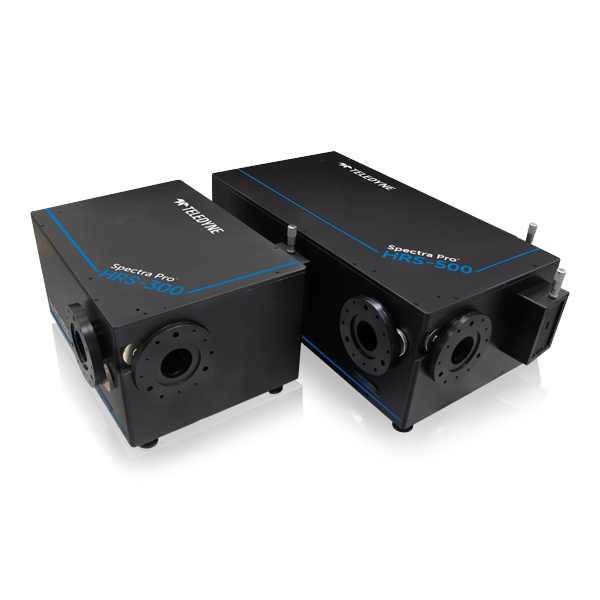
Teledyne Princeton Instruments provides a number of ideal solutions for challenging spectroscopy applications, especially PL on novel materials. In this study, PL spectra were acquired using the SpectraPro HRS‑500 spectrograph equipped with a 150 g/mm grating and the PyLoN 100 CCD detector. This proven combination provided the spectral resolution necessary to cleanly separate the closely spaced excitonic peaks that serve as fingerprints of each magnetic state. The ability to reliably distinguish peaks corresponding to FM, AFM and Mixed configurations respectively was critical to the study's central finding: the identification of a previously unobserved intermediate "Mixed" magnetic state arising from interfacial charge transfer.
The sensitivity of the PyLoN CCD enabled the detection of PL emission from atomically thin flakes at millikelvin to liquid helium temperatures, where signal levels are at their most challenging. This allowed the team to build up comprehensive temperature‑dependent and gate-voltage-dependent datasets across the full range of experimental conditions. The high-quality spectral data collected through this system provided the definitive evidence needed to distinguish the three magnetic states, evidence that integrated intensity alone (captured with the avalanche photodiode used for mapping) could not fully provide.
Together, the SpectraPro HRS-500 spectrograph and PyLoN CCD delivered the spectral precision and detection sensitivity that underpinned one of the study's most important conclusions: that charge transfer from graphene fundamentally alters the magnetic landscape of CrSBr at the level of individual atomic layers.
Reference
Hong, C., Sun, Z., Sheng, Z., Wu, S., Chen, Y., Tian, M., Wan, N., Mi, Q., Liu, Z., Chu, W. & Wu, S. (2025). Charge transfer governed interlayer magnetic coupling and symmetry breaking in a van der Waals magnet. Nature Communications, 16, 9498. https://doi.org/10.1038/s41467-025-64555-z
 Learn More About The SpectraPro HRS